
Amazon's 16 Leadership Principles are the operating values every candidate is measured against, in every round of Amazon's interview loops. This guide lists all 16, gives you a one-page cheat sheet, and shows how Amazon interviewers test them, with real questions and prep built from conversations with a former Amazon VP and six Bar Raisers.
✔️ Conducted 50+ coaching sessions with Amazon candidates
✔️ Reviewed dozens of Amazon Leadership Principles interviews
✔️ Interviewed Ethan Evans, a former Amazon VP
✔️ Consulted 6 Amazon Bar Raisers
Read real Amazon interview experiences from recent candidates.
The Amazon Leadership Principles Interview with a former Amazon VP.
Ethan Evans, former Amazon VP, says:
The best way to pass an LP interview is to be really skilled.
Knowing how to answer the questions and being familiar with the Principles is the icing on the cake.
In my own interview, not only did I succeed, but I also got an 'all-inclined loop,' which means every interviewer said, 'Hire.'
And I didn't know a thing about Amazon's Leadership Principles. I had never heard of them.
All I did was answer the questions and be engaged and forward.
Amazon's 16 Leadership Principles
Amazon has 16 Leadership Principles, the operating values it hires, promotes, and makes decisions against. They're the characteristics Amazon looks for in every candidate it hires, and Amazon publishes the full set on its official jobs site.
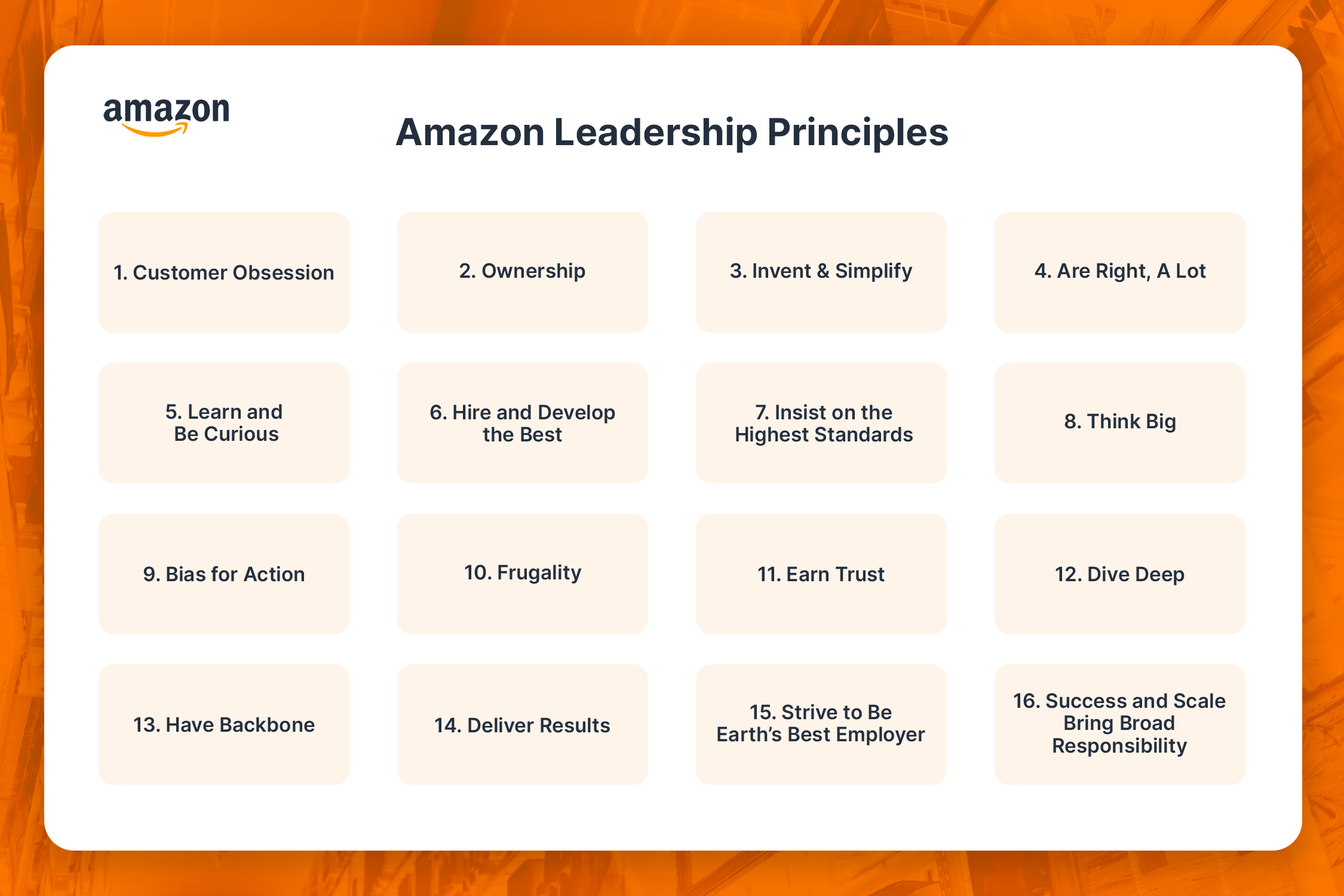
- Customer Obsession: Leaders start with the customer and work backward. They obsess over customer needs and work vigorously to earn and keep trust.
- Ownership: Leaders act on behalf of the entire company, take long-term responsibility, and never say, "That's not my job."
- Invent and Simplify: Leaders drive innovation and simplicity. They are open to ideas from everywhere and are willing to be misunderstood at times.
- Are Right, A Lot: Leaders have strong judgment, make good decisions, and seek diverse perspectives to challenge their own thinking.
- Learn and Be Curious: Leaders are lifelong learners, constantly seeking to improve and explore new possibilities.
- Hire and Develop the Best: Leaders recognize exceptional talent, coach others, and work to build a stronger organization by hiring and developing top talent.
- Insist on the Highest Standards: Leaders set high standards, constantly raise the bar, and ensure quality and long-term solutions.
- Think Big: Leaders communicate bold visions and pursue ideas that inspire and deliver outsized results.
- Bias for Action: Leaders value speed and calculated risk-taking. They understand that many decisions are reversible.
- Frugality: Leaders achieve more with less. Resourcefulness and self-sufficiency are core behaviors, not constraints.
- Earn Trust: Leaders build trust by listening well, being candid, treating others with respect, and holding themselves accountable.
- Dive Deep: Leaders stay connected to details, validate data, and are hands-on in understanding the work at all levels.
- Have Backbone; Disagree and Commit: Leaders respectfully challenge decisions when needed and fully commit once a path is chosen.
- Deliver Results: Leaders focus on key inputs and deliver them with quality and timeliness, despite obstacles.
- Strive to be Earth's Best Employer: Leaders prioritize safety, inclusivity, employee growth, and fun, seeking to build a better workplace every day.
- Success and Scale Bring Broad Responsibility: Leaders act with awareness of the global impact of their actions and aim to leave things better than they found them.
Amazon Leadership Principles resources
- Practice with our Amazon interview question bank
- Read real Amazon interview experiences
- Our full Amazon behavioral interview guide
- Amazon interview overview and company hub
What is the Leadership Principles interview?
The Leadership Principles (LP) interview isn't a single scheduled round. It's the way Amazon runs its behavioral and cultural-fit assessment: interviewers score you against the 16 Leadership Principles across every round of the loop.
Amazon standardizes this assessment across all interviews, and it's among the most demanding behavioral evaluations in tech. Companies like Netflix and Apple tend to use a one-off behavioral round instead.
Preparing for Amazon's LP questions also prepares you for the less complicated behavioral rounds at other tech companies.
Leadership Principles run through every round
There's no separate LP round in Amazon's interviews. Interviewers assess the Leadership Principles throughout the entire loop, so expect LP questions in every round regardless of the topic, including technical assessments. Some onsite rounds do end up focused almost entirely on the Leadership Principles, even though they aren't labeled as an "LP round."
The questions come from the same bank across technical roles, so software engineers, product managers, and other technical candidates see largely the same LP questions and are scored against the same Principles.
What shifts is emphasis: interviewers tend to emphasize the Principles most relevant to your role, so PMs see more "Customer Obsession" and "Think Big," while engineers get more "Ownership" and "Deliver Results." The bigger differences still come from your level rather than your role.
Amazon's standardization raises the bar
Most behavioral interviews are subjective. Amazon counters that with training and consistency: it runs the second-most thorough interviewer training of any FAANG company, behind only Meta, and its interviewers are calibrated to score the same Principles the same way.
At other FAANG companies like Google, behavioral rounds can feel casual, often just a check for red flags. Amazon interviewers instead work through the Leadership Principles deliberately, which makes the round more rigorous and harder to improvise through.
One Amazon Bar Raiser says:
Amazonians take the LPs seriously in meetings and real-life situations.
For example, in real meetings, Amazonians will discuss our "Customer Obsession."
It isn't like values at other companies, which are typically just BS things on a poster.
Amazon Leadership Principles cheat sheet
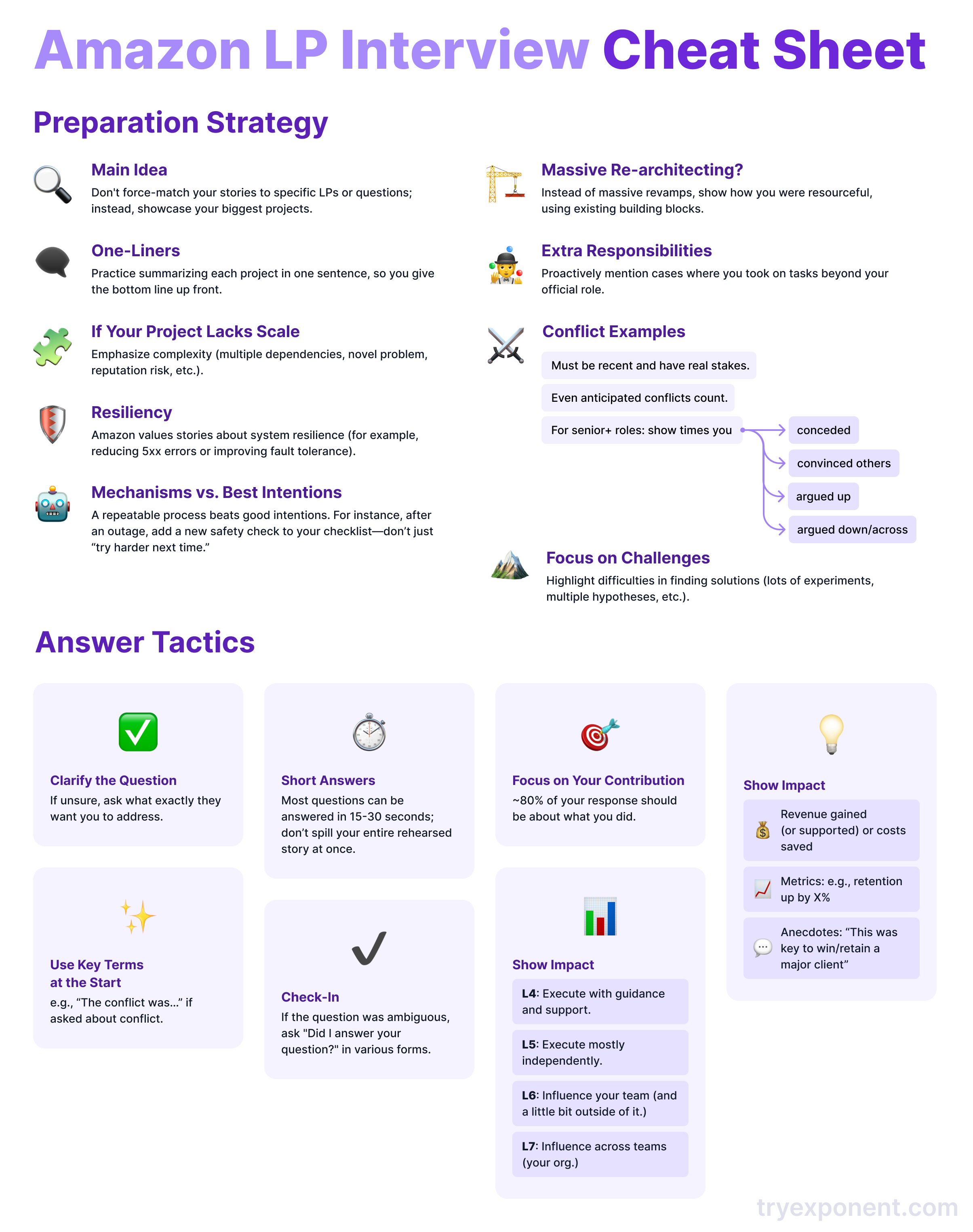
Here's a printable cheat sheet to keep with you during Amazon interviews.
How to prepare for the Amazon LP interview
Preparing for the Amazon Leadership Principles interview comes down to four steps, each built on a small set of projects you understand deeply enough to discuss from any angle:
- Choose your three strongest projects
- Sort them into productivity, failure, and conflict buckets
- Develop each project into a story
- Avoid the dealbreakers, red flags, and risks
Practice against real Amazon behavioral questions as you build each story.
Step 1: Choose your three strongest projects
Pick the three projects that best show your impact, because a full LP round is built around a few deep stories you can discuss from any angle. To find them, ask:
- Which projects had the highest stakes?
- Which had the most impact?
- Which involved your most complicated decisions?
Plan to return to these three projects throughout the loop, working them into answers wherever they fit, without forcing a story where it doesn't belong or sounding scripted.
One Amazon Bar Raiser says:
It's okay to only talk about 2-3 projects the whole time (especially if the projects span over a year) as long as your stories are disambiguated.
It can even be the same overarching project if you frame it differently each time to highlight different skills. Such as, "Here's the time when I did the backend," "Here's when I solved a bug on the front end," and "Here's what I accomplished when I worked on the database aspect of the project."
Just don't talk about one project in the same way the whole time. I can remember a lot of debriefs where we look up and go, "This candidate talked to all of us about the same story, didn't they?"
Step 2: Sort your projects into three buckets
Group your top projects into three buckets so you always have a story ready for the Principle an interviewer targets. Aim for at least one project per bucket (two is better), and remember a single project can cover more than one.
| Bucket | What belongs here |
|---|---|
| Productivity | Your biggest wins: what you delivered for the business and the customers you helped. |
| Failure | Mistakes you owned and learned from, including times you got negative feedback. |
| Conflict | Disagreements you worked through, whichever side "won." |
Know your chosen projects thoroughly. Practice out loud, record yourself, and run mock interviews until you can discuss each one from any angle. During the interview, don't worry about which Principle you're being tested on; answer the question clearly and honestly, and the LP signal follows.
Expect detailed follow-ups on each story.
For a productivity story:
- What technology problem were you solving, and what type was it (scale, resiliency, etc.)?
- What customer or business problem were you solving?
- Did it have real stakes, and how was it complex?
- What did you do, and what data did you gather to test your hypotheses?
- What was the hardest part of finding your solution, and why?
- What was your solution, and what over-engineered options did you avoid?
- What was the outcome and its impact?
One Bar Raiser flagged a common gap here: candidates usually explain either the customer problem or the technical problem, but rarely both. Cover both sides.
For a failure story:
- What was the mistake, and were you upfront about it?
- Did it have real consequences (reputational damage, a lost customer, other fallout)?
- Was it recent, ideally within the last couple of years?
- What was your initial reaction, and how did you respond once you regrouped?
- Did you hold yourself accountable and communicate what you owned, including to leadership?
- What would you do differently, and how did you prevent a repeat?
For a conflict story:
- What was the conflict?
- Did you show that you understood the other side?
- How did you address the concerns you expected from them?
- What objective evidence did you gather?
- How did you try to resolve it, and were you convinced either way?
- Did you escalate, and had you done enough on your own first?
- What was the outcome, and how did you communicate it?
- What did you learn?
Handling conflict questions
Conflict comes up throughout the loop, and Amazon cares that you worked to resolve it; who won matters less. Show that you gathered data, made your case, understood the other side, and reached a resolution so the work could continue. A disagreement doesn't have to be a confrontation: it can be a time you saw a better approach and gathered evidence for it, even if you never used it.
Escalation is welcome at Amazon once you've done what you can on your own, so escalate early and often after real due diligence. If you rarely escalate in your current role, say so honestly: "This isn't a place that encourages escalation, so I don't have many examples."
At L6 and above, prepare two conflict examples, one where you convinced the other side and one where they convinced you, across different types of stakeholders. At L5 and below, either direction works. Skipping the work of understanding other people's views is a subtle way to fail "Earn Trust," and for senior candidates it can be a dealbreaker.
One Amazon Bar Raiser says:
For L6, if all your disagreements are about "What technologies should we choose for this greenfield project," those are not very high-impact decisions.
The stakes aren't that high. It takes a long time to determine if that decision was good or bad.
A lot of times, that decision is not going to make or break a project.
The bar I expect for an L6's disagreements is the stakes have to be high enough that this affects the business folks (PMs, designers, etc.) as opposed to simply the engineers on this one team.
For example, deciding between building a single-page web app and a traditional web page.
Step 3: Develop each project into a story
Turn each project into a story an interviewer can follow: lead with the result, quantify the impact, and highlight the hardest judgment calls. Start with the strategies for building the stories, then the tactics for delivering them.
To strengthen each story:
- Reduce each project to a one-line result you can state before the details.
- Don't pre-match stories to specific Principles; understand your projects deeply and let the signal come through.
- If a project lacks scale, show complexity another way: dependencies, a novel challenge, or reputational risk.
- Emphasize resiliency first (the failure points customers see), then scalability, performance, and security.
- Favor repeatable mechanisms over good intentions, like adding a safety check to your deployment checklist after an outage.
- Reuse existing building blocks instead of re-architecting whole systems, which Amazon treats as high-risk at its scale.
- Mention where you took on work beyond your formal role.
- Keep conflict stories recent and high-stakes; even an argument you anticipated but avoided can count.
- Highlight your hardest projects, especially where the path forward was unclear or took real experimentation.
During the interview:
- Clarify the question before answering if there's any doubt ("Do you want me to talk about conflicting priorities?").
- Keep your initial answer to roughly 15-30 seconds, then wait for follow-ups instead of reciting a full story.
- Keep about 80% of each answer on your individual contribution rather than your team's.
- State impact every time: a dollar figure, a metric ("increased retention by Y%"), or a specific customer outcome.
- Put keywords from the question in your first sentence ("The conflict was with a Principal Engineer about an internal dependency").
- Ask whether you answered the question, varying how you phrase it each time.
- Match depth to your level: L4s execute with support, L5s execute independently, L6s influence their team, L7s influence across the org.
When numbers are hard to pin down, a before-and-after estimate works.
Say you automated a manual process that took 1 hour, done by 50 employees at $75/hour, 2-3 times a week: 1 x 50 x 2.5 x 52 x 75 comes to about $487,500 in yearly impact. Since that's below Amazon's $1 million scale bar, you might frame it as "this saved close to $500k a year, which mattered for our company," or "this ran about 60x faster than the manual process."
A few situations need extra care if you're a nonstandard candidate:
- From a startup background, counter the assumption that you move too fast and break things by showing where you built carefully on existing blocks. For example, "we built an image processing pipeline, then extended it to handle video and other large assets."
- With only smaller-scale projects, show complexity through growth rate, internal and external dependencies, engineering effort, or the reputational, scheduling, and customer stakes of getting it wrong.
- If you can't find metrics, lower the bar to your best honest estimate, then ask the obvious questions: revenue generated or supported, costs cut, users reached, improvement over a benchmark.
One Amazon Bar Raiser said:
Maybe 25% of the candidates we hired came from a background exclusively of companies I'd never heard of.
Another Amazon Bar Raiser said:
I can think of candidates who didn't look good on paper but got hired anyway, and they usually would give a very thoughtful answer for "Why Amazon?" or "Why are you interested in this role?"
Also, they would recognize that I was unfamiliar with their company or product, and they did a very clear job of explaining those to a layperson.
Step 4: Avoid dealbreakers, red flags, and risks
Most LP failures trace to a short list of avoidable mistakes, from instant rejections down to smaller point losses.
Dealbreakers that can fail you on their own:
- Clearly not preparing for the Leadership Principles.
- A negative score on "Earn Trust" or "Have Backbone; Disagree and Commit," which can sink an otherwise strong loop. Having no disagreement stories can be as damaging as coming across as someone who's hard to work with.
Red flags that can cost significant points:
- Giving too much detail in your first answer.
- Not answering the question asked, usually from a canned response or a misread.
- Focusing on what the team did instead of your own contribution.
- Not citing metrics or impact.
- Saying "I don't have an example for that" more than once or twice in a round.
- Getting lost in unimportant details of a conflict, especially trying to prove who was right, or never clearly stating what the conflict was.
- For L7s and up, only disagreeing across or down the org chart.
- Disagreements with stakes that are too low.
Risks that add up when they cluster:
- Leaning on STAR to design answers; it works better as a filter after your stories exist.
- Trying to guess which Principle a question targets.
- Citing revenue or cost savings under $1,000,000.
- Describing a manual process without explaining why you didn't automate it.
- Discussing a project you finished in one sprint, which reads as low-complexity.
- Using a project from more than 3-4 years ago, given Amazon's recency bias.
- For L6 candidates, only having conflicts down or across the org chart.
- Claiming both a tight timeline and very high quality, which can sound implausible together.
- Re-architecting an entire system.
One Amazon Bar Raiser said:
To build an entirely new system [at our scale], productionize it, and make it stable usually takes a couple of years of work.
That's sometimes the right thing, but usually not right for us.
Amazon leveling advice
LP interviews look similar across technical roles: the questions come from the same bank and interviewers score the same Principles, even if the emphasis shifts a bit by role. The differences that matter for prep are between levels.
Amazon's leveling system is offset by one compared to the rest of the FAANG companies. For example, an L4 role at Amazon typically aligns with an L3 role elsewhere. Keep this in mind if you're comparing positions or preparing for interviews across different companies.
If your projects don't convey the right amount of scope and complexity, you will get down-leveled or rejected.
- L4 and L5: Responsible for their own work
- L6: Influencing their team and a little bit outside of it
- L7: Influencing across teams (their org)
Advice for L4 and L5
If you're L4 or L5, you do most of the hands-on work in the organization, and your job is to show you can execute. The key difference between L4 and L5 lies in independence and autonomy: L4 delivers with guidance and support; L5 delivers mostly independently.
Advice for L6
An L6 applies technical solutions to business problems. They can be given an input, such as "we need a page that renders really quickly," and provide an output, such as "we need to do this architecture or this technology." An L6 is like a Team Lead at other companies.
You need influence over at least 3-4 engineers to deliver strategic initiatives, and an L6 needs examples of mentorship or hiring. L6s are also expected to exert some influence over other teams, but not a lot. At the very least, they should align their team with upstream or downstream teams interacting with their services.
Advice for L7
L7s need to be exceptional at influence across an org, be able to say no, and get buy-in from executives. For example, if they're a product manager, they know how to work with GTM, sales, finance, and legal. They've probably also worked on a project with legal complexity or privacy challenges, and can think about a P&L and forecasting. They're cross-functional experts who can influence executives and push back on them directly when needed.
What's important for L7 is how many cross-functional teams you've influenced, and how big your influence was. And what's the level of leadership you've presented to? What type of product or service have you worked on, how complex was it, and how big was the scale?
One Amazon Bar Raiser said:
At L7, I look for:
• Is this person helping a manager solve the manager's problems?
• Are they helping the manager to be out of the manager's job?
• Are they helping with pain points?
• Are they driving the team?
• Can they go and conduct meetings proactively?
• Can they solve problems in ambiguous areas?
Common Leadership Principles mistakes
The most common way to fail the LP interview questions is to over-rehearse: writing out a full answer to a question like "Deliver Results," memorizing it, and reciting it word for word. A prepared script falls apart as soon as the question shifts.
One Amazon Bar Raiser said:
I don't think there's value to practicing "this is my answer to a Deliver Results question."
Don't get too attached to your exact wording or treat answers as scripts. Most interviewers can tell when a response is memorized, and a rehearsed answer aimed at the wrong question is one of the fastest ways to lose credibility.
Another Amazon Bar Raiser said:
You can come off as inauthentic if, when I ask you a question, it feels like I accidentally pressed play on a recording.
Leadership Principles interview questions
Success in Amazon's Leadership Principles interviews comes from knowing your top projects deeply enough to tie to any Principle, so treat the specific questions below as practice once your stories are solid.
Here are some common Amazon Leadership Principles interview questions:
- Tell me about a time you disagreed with someone and how you resolved it.
- Tell me about the most challenging technical problem you've worked on.
- Tell me about a time you used data to make a decision.
- Tell me about a time when you had to make a quick call on something important. What did you do?
- Tell me about a time you got a piece of critical or negative feedback.
- Tell me about a time you came up with a simple solution for a complex problem.
- Tell me about a time when you identified and resolved customer pain points.
- Tell me about a time you made a mistake.
- Tell me about a time when you made short-term sacrifices for long-term gains.
- Describe a challenging project you worked on and what made it difficult.
Put your prep to work on interview day
In the interview itself, resist the urge to work out which Principle each question targets, and answer the question in front of you. Trying to guess the LP is a common way candidates go wrong. Clarify the question if you need to, then give one specific, real example rather than a rehearsed script.
This is the payoff of preparing a few projects in depth: with strong stories ready, you can answer naturally and let the interviewer, who is assigned to score specific Principles, map your example to the right one.
Amazon Leadership Principles FAQ
What are Amazon's Leadership Principles?
Amazon's Leadership Principles are 16 operating values that define how the company hires, promotes, and makes decisions. Interviewers are assigned specific Principles to assess, so candidates are measured against them in every round of the loop.
What are the two newest Amazon Leadership Principles?
The two newest Amazon Leadership Principles, both added in 2021, are "Strive to be Earth's Best Employer" and "Success and Scale Bring Broad Responsibility."
Are Amazon Leadership Principles tested in every interview round?
Amazon assesses the Leadership Principles across the entire interview loop rather than in one standalone round. Each interviewer is assigned specific Principles, and LP questions appear even inside technical rounds.
What is an Amazon Bar Raiser?
An Amazon Bar Raiser is an experienced interviewer from outside the hiring team whose job is to keep the hiring bar high. The Bar Raiser does not report to the hiring manager, and has veto power over the final decision.
How do you prepare for Amazon Leadership Principles questions?
Prepare for Leadership Principles questions by choosing your top three projects and bucketing them into productivity, failure, and conflict stories, each with clear metrics and your individual contribution. Use STAR as a filter after your stories are built, and practice with mock interviews until you can discuss each project from any angle.
Do different roles get different Leadership Principles questions?
Leadership Principles questions are largely the same across technical roles at Amazon, drawn from one shared question bank, though interviewers emphasize the Principles most relevant to your role. The meaningful differences are by level: higher levels (L6+) need higher-stakes, cross-team examples.

Your Aced membership awaits.
Aced is the fastest-growing tech interview prep platform. Get free interview guides, insider tips, and courses.
Create your free accountRelated Courses

Amazon Interview Prep Course

Amazon Software Development Manager (SDM) Interview Course
Related Blog Posts

Amazon Behavioral Interview Questions and Answers (2026 Guide)

What Are The Amazon Leadership Principles?

All the Ways to Answer the "Why Amazon?" Interview Question