Below, we'll show you how to write the perfect Google resume.
Or, use our Google resume templates from candidates who got the job.
Fewer than 1% of job seekers actually land a job at Google, making your resume an important step in standing out!
Key Google Skills
Here’s the criteria Google has top of mind when reviewing resumes:
Structured Thinking & Problem Solving
Google loves resumes that show:
- Clear problem → your solution → measurable result (X-Y-Z format)
- Initiative and critical thinking
- Comfort with ambiguity and the ability to work across functions
Impact > Responsibilities
Google prefers results-focused over task-based resumes. Use data to quantify your achievements:
- % improvements
- Time saved
- Revenue gained
- Operational efficiencies
Role-Specific Skills
Customize the resume for the position. Google looks for:
- Technical depth for engineering or data roles (Python, C++, SQL, TensorFlow, etc.)
- Product or program impacts
- Cross-functional collaboration for generalist roles
Communication & Collaboration
Whether you're applying for software engineering or BizOps, Google values:
- Clear, concise writing
- Experience working across teams, stakeholders, and regions
- Leadership in group settings, even without formal authority
Growth & Leadership
Google wants candidates who show:
- Growth mindset
- Internal promotions
- Mentorship or team leadership
- Contributions beyond job scope
Googleyness (Culture Fit)
Hard to define, but includes:
- Comfort with ambiguity
- Intellectual curiosity
- Openness to feedback
- Team-first attitude
- Commitment to inclusivity and equity
Formatting Tips
- Length: 1 page (0–5 years), 2 pages max if senior
- Format: Clean, no dense paragraphs, use bullet points
- Fonts: Standard (Arial, Calibri, Times New Roman), 10–12 pt
- File: PDF preferred
Template: Engineering Manager
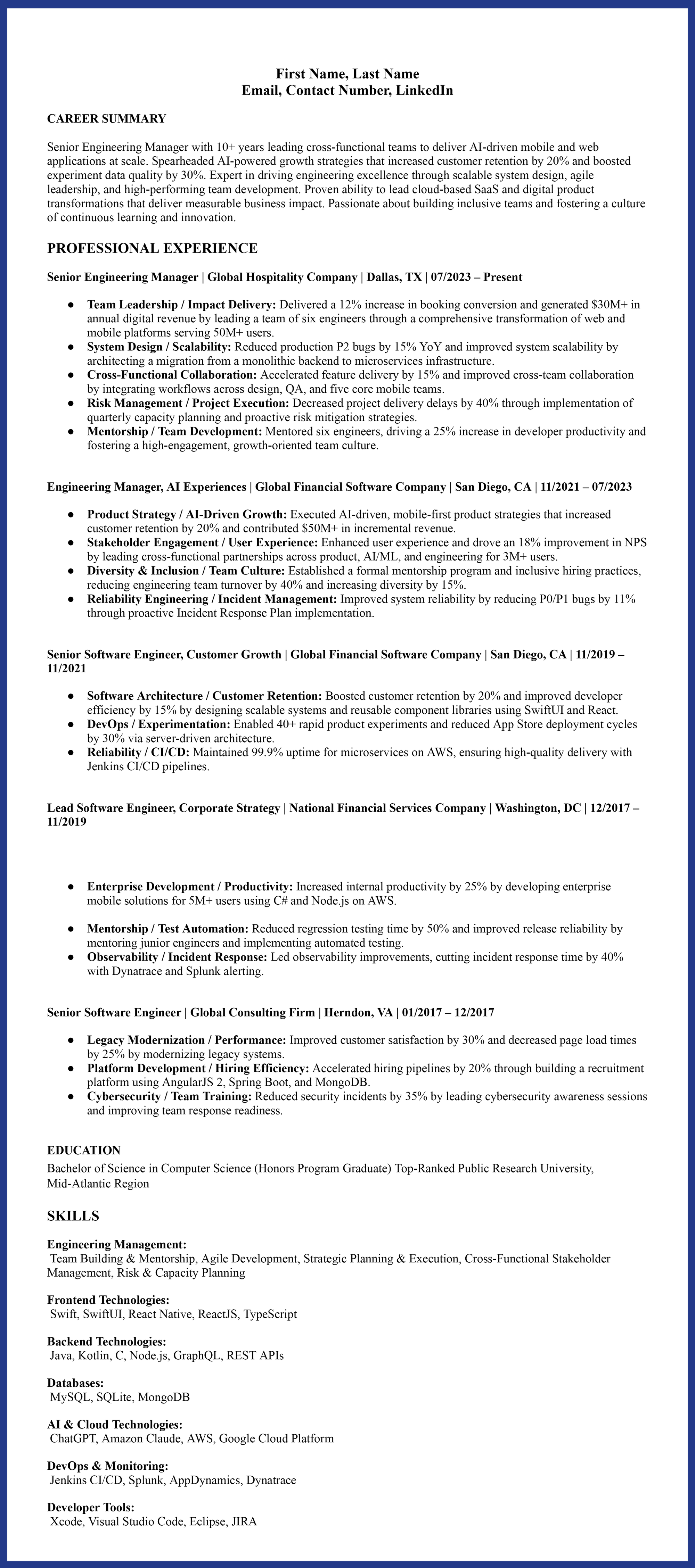
What makes this a great engineering manager resume for Google?
Structured Thinking & Problem Solving
- The structure “Skill: Action → Result” makes it easy to scan.
- Showcase initiatives, technical strategy, and leadership across multiple domains.
Impact > Responsibilities
- Most bullets emphasize quantifiable results
- “12% increase in booking conversion,”
- “$30M+ in revenue,”
- “40% reduction in turnover”.
- Avoids vague task descriptions. Focuses on outcomes and business value.
Role-Specific Skills
- Showcases technical depth and breadth (cloud, AI, microservices, DevOps tools).
- Explicit alignment of core skills, as outlined in each bullet, highlights relevant expertise for Google’s technical or leadership roles.
- AI and cloud leadership experiences stand out as necessary for many Google roles.
Communication & Collaboration
- Multiple bullets highlight collaboration, mentorship, and stakeholder engagement.
- Communication style is clear, concise, and professional.
Growth & Leadership
- Strong evidence of mentorship, team development, inclusive hiring, and leadership progression.
- Demonstrates both technical leadership and people management, which Google highly values.
Googleyness (Culture Fit)
- Mentions of inclusive hiring, mentorship, and risk management signal a team-first mindset and adaptability.
- Some soft indicators of intellectual curiosity and openness could be made more explicit; however, overall, they are effective.
Format & Style
- A clean, bullet-point format with aligned skills enhances readability.
- Length and detail seem appropriate for senior leadership roles.
Template: Product Manager
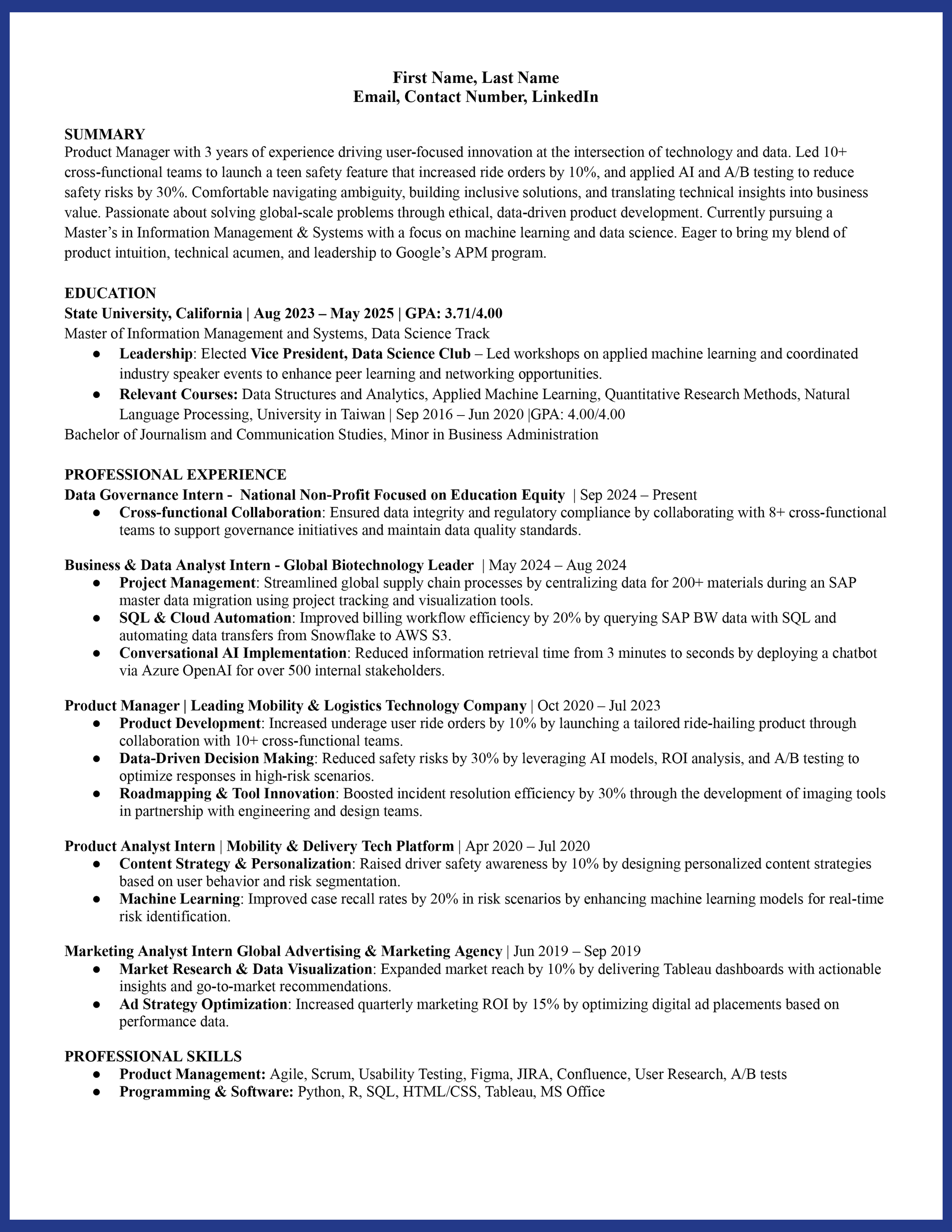
What makes this product manager's resume stand out to Google recruiters?
Structured Thinking & Problem Solving
- Bullet points clearly follow the problem → action → result structure, which Google values highly.
- Example: “Reduced safety risks by 30% by leveraging AI models, ROI analysis, and A/B testing…”
- Frame solutions using structured thinking (e.g., chatbots, data centralization, ML improvements).
Impact > Responsibilities
- Almost every bullet includes quantified outcomes, such as:
- a 10% order increase,
- a 30% risk reduction,
- and a 15% ROI gain, among others.
- Shifts focus away from tasks and clearly expresses business or user impact.
Role-Specific Skills
- The resume showcases strong product development, data analytics, and ML/AI literacy.
- Skills like SQL, Python, A/B testing, usability testing, and OpenAI deployments are highly relevant.
Communication & Collaboration
- Highlights cross-functional work often (engineering, design, data, global teams), which is essential for Google PMs.
- Examples such as leading workshops, collaborating with over 10 teams, and coordinating speaker events demonstrate initiative and clear communication.
Growth & Leadership
- VP of Data Science Club and multiple indicators of intern-to-full-time progression demonstrate leadership and initiative.
- Shows a clear upward trajectory from analyst to PM roles.
Googleyness (Culture Fit)
- A passion for user-focused solutions, applied data science, and leadership in extracurricular activities demonstrates curiosity, empathy, and initiative.
- The work with education equity + internal tooling (e.g., chatbots) suggests a service mindset.
Format & Style
- Clean, scannable layout
- Quantified, action-oriented bullets
- Clear progression and appropriate section headers
- Uses a modern tech/product stack in the skills section
Why Resumes Matter
You need to optimize your resume for two different audiences:
- Applicant Tracking Systems
- Human reviewers, recruiters, and hiring managers
Optimize for ATS
Applicant Tracking Systems scan resumes for specific keywords that match the job description.
- Summary Section: Incorporate high-impact keywords that reflect your core competencies and align with the roles you're targeting.
- e.g., project management, data analysis, stakeholder engagement, or cloud infrastructure could be included.
- Work Experience: Use job-specific terminology and action verbs such as led, developed, implemented, optimized, and analyzed. Mirror the language used in job postings to increase match rates.
- Skills Section: List both hard and soft skills. Include tools, technologies, and methodologies (e.g., Python, Agile, Salesforce, SEO, Six Sigma).
Optimize for Recruiters
While ATS gets your resume seen, recruiters need to understand the depth of your contributions and the scale of your impact:
- Work Experience Descriptions: Go beyond listing duties. Highlight the why and how behind your actions. For example:
- Product Development: Increased underage user ride orders by 10% by launching a tailored ride-hailing product through collaboration with 10+ cross-functional teams.
- Data-Driven Decision Making: Reduced safety risks by 30% by leveraging AI models, ROI analysis, and A/B testing to optimize responses in high-risk scenarios.
- Quantify Achievements: Use metrics to demonstrate success, such as percentages, dollar amounts, time saved, or customer satisfaction scores.
- Showcase Scope: Mention the size of teams, budgets, or projects to give recruiters a sense of scale.
Google’s Hiring Process
The Google hiring process is:
- Application
- Resume Screen
- Recruiter Screen Call
- Phone Interview
- Onsite Interview
Google’s hiring process consists of several stages that can take anywhere from 2 to 3 weeks to 6 to 8 weeks.
This could be because of team matching, scheduling, and overall timing.
Once all applications are received, a team member at Google reviews the applications submitted to their job postings and scans each resume to identify qualified candidates for the recruiter screening call.
Google uses a combination of technology and human-curated review processes to determine if a resume is relevant for the role, and then decides whether to forward the candidate to the next step in the process.
Hiring Packet
The hiring packet typically can include, but is not limited to:
- Resume
- Interview Feedback
- Recommendations by the Recruiter
- Hiring Manager Feedback (when applicable)
- Team Match and Leveling Recommendations
In the final stages of deciding whether to hire a candidate, recruiters and hiring managers will again review the candidate’s packet holistically, including the resume, to determine if there’s a good fit with the candidate.
Format
Google receives millions of job applications every year. To get through them all, recruiters have to move quickly.
The goal is to demonstrate that you, as a candidate, meet the job qualifications and have made relevant and significant contributions and impact in your past experience, within the first 6-8 seconds a recruiter (or hiring manager) lays eyes on your resume.
Keep these things in mind when formatting your Google resume:
- Use Reverse-Chronological Order: List your most recent work experience first.
- Keep it Brief: Use a single page. You need to be concise and articulate the depth and breadth of your work. As a best practice, limit your resume to one page for less than five years of experience. With over five years of experience, expand to two pages, with most of your accomplishment bullet points emphasized on your two most recent work experiences.
- Be ATS-Friendly: Ensure your resume passes through Applicant Tracking Systems (ATS) by using simple formatting and incorporating relevant keywords throughout (e.g., Core Skills, Technologies, Frameworks). Otherwise, it may never reach a hiring manager.
- Professional Design: Use a simple, professional format with easy-to-read fonts, such as Times New Roman or Calibri.
- File: PDF Preferred
Header
Your Google resume’s header is the first thing the recruiter will see.
This section should contain all of your essential personal and professional information.
At the top of the page, include your name, contact details, job title, and any relevant professional certifications or titles.
If you have any other online profiles or portfolios that showcase your skills and experience, please add those links as well.
Resume Summary
The summary sets the tone of your resume.
For early career candidates, focus on your education and relevant projects.
The summary framework includes:
- Who you are
- What you do
- What you’re known for
- This is a significant career accomplishment. (e.g., "Led, developed, and launched X product into a new target market, resulting in X% market adoption rate and $XXX revenue."
- Where you are going next (Your target role – function and/or industry)
Focus on your notable skills and past achievements, such as scalable and complex model deployments, and building scalable and robust software pipelines.
Don't use this section to talk about your personal career ambitions.
Example:
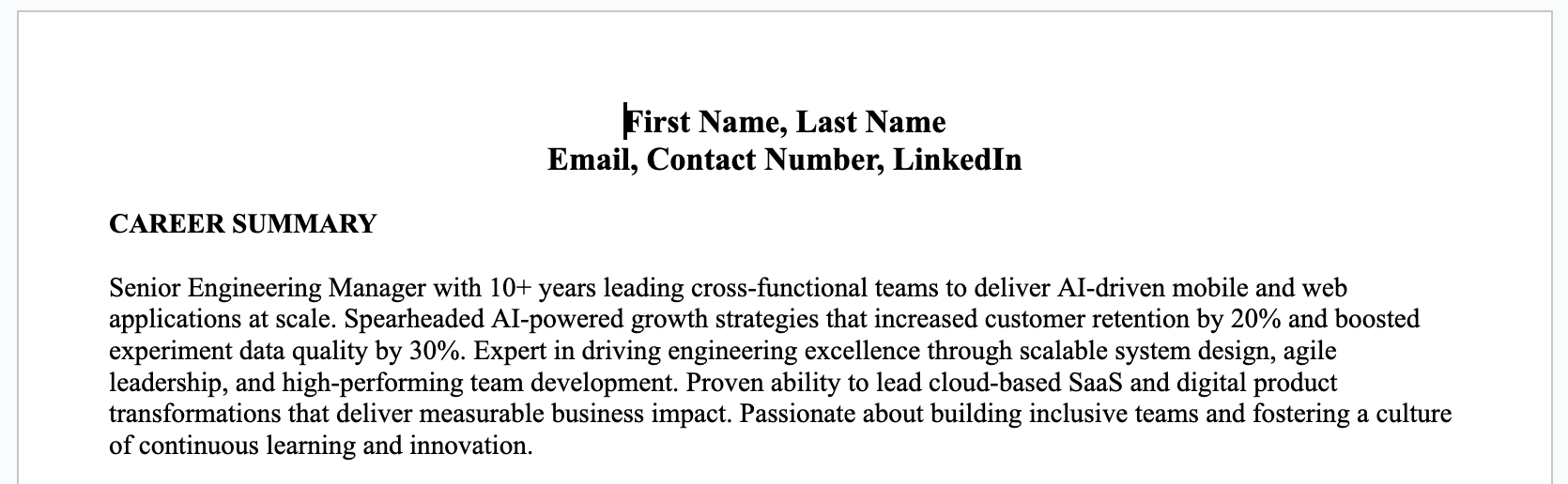
Product Manager with 3 years of experience driving user-focused innovation at the intersection of technology and data. Led 10+ cross-functional teams to launch a teen safety feature that increased ride orders by 10%, and applied AI and A/B testing to reduce safety risks by 30%. Comfortable navigating ambiguity, building inclusive solutions, and translating technical insights into business value. Passionate about solving global-scale problems through ethical, data-driven product development. Currently pursuing a Master’s in Information Management & Systems with a focus on machine learning and data science. Eager to bring my blend of product intuition, technical acumen, and leadership to Google’s APM program.
Work Experience
There are plenty of great articles out there on writing an effective resume, and many resume templates you can make use of.
However, especially for Google roles, there’s one key secret to crafting the perfect resume that most people miss: studying and aligning your resume with the job description's skills.
Align your accomplishments with the core skills outlined in your target role or job description.
Use a skill: accomplishment framework to allow your resume to read like a job description, aligning your skills and accomplishments to most job descriptions.
Show your direct impact on core KPIs like revenue, growth, or retention.
Software Engineer Example:
- Collaboration Tools (Agile Development): Mentored 3 engineers, improving feature delivery velocity and enabling successful completion of complex features like egress pool management and Kerberos caching.
- Scalability & Performance (Concurrency, Caching): Delivered 70% memory savings on large-scale egress workloads by co-developing “SELECT INTO object storage” using Parquet format, enhancing performance for terabyte-scale operations.
- System Architecture (Microservices Architecture): Spearheaded cross-team collaboration with 5+ engineers to design ETL script integration, extending core platform features previously limited to self-managed deployments.
Product Manager Example:
- Product Development: Increased underage user ride orders by 10% by launching a tailored ride-hailing product through collaboration with 10+ cross-functional teams.
- Data-Driven Decision Making: Reduced safety risks by 30% by leveraging AI models, ROI analysis, and A/B testing to optimize responses in high-risk scenarios.
- Roadmapping & Tool Innovation: Boosted incident resolution efficiency by 30% through the development of imaging tools in partnership with engineering and design teams.
Education
For most candidates, the education section of their Google resume will be a short section listed below their work history. List your degree(s), relevant coursework, and certifications.
For recent graduates, you can include additional details, such as relevant projects or internships, and place this section immediately below the summary.
The education section should not occupy much space on your resume unless you’re a recent graduate or an early career software engineer with little experience.
For those transitioning from other fields, condensing the education section to emphasize only the qualifications most applicable to Software Engineering may be beneficial.
Skills
Ideally, your skills should be listed in three different sections at a minimum: your summary, work experience, and skills section.
- Certificates: Certified Digital Product Manager, Product Growth Series (Acquisition, Retention & Engagement, Monetization), ChatGPT Prompt Engineering
- Skills & Tools: B2B SaaS, Cross-platform Products, UI/UX Design, Applied AI/ML, Agile Methodology, Product Analytics, A/B Testing, JIRA, Notion, Zapier, Email Marketing, User Feedback Loop
- Programming: Python, Java, HTML, CSS, SQL, Swift, API
Additional Sections
Enhance your resume by including additional sections:
- Publications: Highlight your research contributions.
- Presentations: Show your ability to communicate complex topics.
- Awards: Demonstrate industry recognition.
- Professional affiliations: Indicate active involvement in the Software Engineering community.
- Blog posts: Signal your active interest and participation in the ongoing dialogue about current trends or discussions relevant to Software Engineering.
Cover Letters
Google does not require a cover letter.
In most cases, the cover letter is not included in the hiring packet for review.
However, if you do create a cover letter, it may be helpful to dive deeper into:
- Addressing non-obvious career transitions (e.g., switching from academia to industry, or product to data science).
- Highlighting mission alignment (especially for nonprofit, DEI, or sustainability-related teams).
- Showcasing a referral or internal connection in a meaningful way.
- Highlighting and diving deep into a significant professional accomplishment or contribution.
FAQs
How long should a Google resume be? What format works best?
One page for 0-5 years of experience, two pages maximum if senior, with clean formatting using bullet points rather than dense paragraphs.
What keywords should I include to pass Google's automated screening process (ATS)?
Use job-specific terminology from the job description and include terms like project management, data analysis, stakeholder engagement, and cloud infrastructure in your summary and skills sections.
How can I showcase my programming skills when applying for non-engineering roles at Google?
Include programming skills like Python, Java, HTML, CSS, SQL, Swift, and API in your skills section, even for non-engineering roles like Product Manager. You should include them even if they were not used directly in your last position.
Should I include certifications and online courses on a Google resume?
Yes, include relevant certifications like "Certified Digital Product Manager" or specialized courses in your skills section. These are helpful for recruiters and ATS scanning.
How do I present a cross-functional collaboration experience?
Highlight specific examples with numbers, such as "collaboration with 10+ cross-functional team members," to demonstrate scope and impact.
Remember to include outcomes and successful projects, along with specific numbers.
e.g., "Program managed a team of 4 software engineers to deliver a new user onboarding flow that increased lifetime customer value by 8% and reduced database costs by $22k per year."
What's the best way to structure the technical skills section?
Your skills should appear in at least three sections (summary, work experience, and skills section).
Repeat 3-5 times throughout your resume for keyword relevance.
How important is showing "Googleyness" cultural fit on a resume?
It is very important to demonstrate comfort with ambiguity, intellectual curiosity, openness to feedback, a team-first attitude, and a commitment to inclusivity through your experience examples.
Should I include a summary/objective section for Google applications?
Yes, Google recruiters say that well-written resume summaries can be very effective at grabbing their attention and should serve as a 3-5 sentence personal pitch.
What file format should I use when submitting my resume to Google?
PDF is preferred.
Get your resume reviewed by a FAANG recruiter
Your Aced membership awaits.
Aced is the fastest-growing tech interview prep platform. Get free interview guides, insider tips, and courses.
Create your free accountRelated Blog Posts

How To Write An Engineering Manager Resume

How to Write a Great Product Marketer Resume