
System design interviews are harder to pass in 2026, but the questions themselves haven't changed much. What has changed is the bar: more strong candidates are clearing it than there are open roles, so interviewers now separate people on cost, failure modes, and operational judgment that used to be optional.
This guide covers what changed this year, the exact questions candidates were asked at Google, Meta, Amazon, Anthropic, and OpenAI, a five-step framework for the round, and week-by-week prep plans. It accompanies our system design interview course, which includes dozens of mock interviews, video walkthroughs, and practice questions.
What is a system design interview?
A system design interview is a 45- to 60-minute conversation where you architect a software system from scratch. The interviewer gives you an open-ended prompt ("Design Instagram," "Design a rate limiter," "Design a batch inference API for a GPU cluster"), and you decide which components the system needs, how data flows through it, and what trade-offs you're making.
There's no single correct answer and no key to grade against. The interviewer is evaluating how you think through the problem.
What's changed in system design interviews in 2026?
Three things have changed in system design interviews in 2026: the passing bar is higher, AI and LLM infrastructure prompts have moved into general engineering loops, and interviewers now grade cost and operations explicitly. Each change affects how you're graded.
Why the system design interview bar is higher in 2026
The system design interview bar is higher now because the same performance that earned an offer two years ago no longer does. An Airbnb engineering interviewer with over a decade of experience building distributed systems described what he's seeing from the inside:
"Even candidates with stellar reviews are getting declined at the end for an offer. The same high scores are getting fewer offers, even though they used to get the offers."
This isn't unique to Airbnb. Across major tech companies and AI startups, the number of strong candidates passing technical bars exceeds open headcount.
AI and LLM infrastructure questions in system design interviews
LLM infrastructure prompts now reach general software engineer loops, beyond ML engineer roles. A year ago, "design a system that serves an LLM" was reserved for ML positions.
Recently asked system design questions from 2026 include:
- Design a high-level system for a large language model responding to a user query.
- Design a customer-support chatbot integration on top of a third-party LLM platform.
- Distribute one huge file (like model weights) to thousands of machines over a constrained network link.
- Prioritize and allocate distributed compute resources across multiple projects.
- Design safeguards for an AI system that can take actions on behalf of a user.
At Robinhood, a software engineer reported being asked to design a highly distributed training system. At Anthropic, an infrastructure SWE described their loop as "a coding round, a system-design round, a hiring-manager round, a culture round, and a technical-project deep dive, very tied to GPU infrastructure and Anthropic's safety culture."
New system design interview formats to expect
New system design interview formats are appearing alongside the classic open-ended whiteboard problem, which is still the default at most companies. The shift is toward practical prompts tied to a team's day-to-day work, and toward hearing you reason in real time rather than producing a diagram.
At Stripe and some AI labs, instead of one open-ended prompt, candidates receive a single problem broken into three to five sequential parts on a HackerRank-style platform. Each part unlocks only after the prior part's code runs cleanly.
A Stripe SWE said the prompt "is given in several parts and each part's completion is required to proceed to the next, with three parts total under 45 minutes." Another candidate encountered the same pattern on CodeSignal in an in-memory database round.
Practice incremental builds where you ship a working v1 fast, then layer features. Don't over-design v1. The grader needs it to pass before you see v2.
At Amazon, particularly for GenAI Architect roles, the system design screen may have no whiteboard at all. One senior candidate said, "The interviewer said we'll be talking casually. But then, they asked me to design the system verbally without a diagram. Then, he pressed me to upgrade the functional and non-functional requirements on the spot."
Cost and operations in system design interviews
Cost and operations have changed from bonus points to explicit evaluation criteria in system design interviews. A few years ago, "we would add more servers" was an acceptable answer on scale. In 2026, interviewers assess whether you can reason about cost, monitoring, failure modes, and operational maturity.
Discussing cost trade-offs (when to use spot instances, when to cache versus recompute, when serverless makes sense) separates you from candidates who memorize architectures.
System design interview questions in 2026
The most common system design interview questions in 2026 fall into seven categories: AI and LLM infrastructure, classic distributed systems, social and real-time systems, media and content delivery, data pipelines, commerce and transactions, and API and low-level design. The prompts below are real questions candidates reported.
AI and LLM infrastructure questions
- Design a system for an LLM responding to user queries (Google)
- Design the OpenAI Playground (OpenAI)
- Design a customer-support chatbot on a third-party LLM (rate limits, fallback, state)
- Design a batch inference API for a GPU cluster (Anthropic)
- Design an agentic AI system that can autonomously adapt to new tasks (Anthropic)
- Distribute model weights to thousands of machines over a constrained link
- Prioritize and allocate distributed compute resources across projects
- Design safeguards for an AI system that takes actions on behalf of a user
- Design a highly distributed training system (Robinhood)
Classic distributed systems questions
- Design an over-the-air software update system for millions of devices (Microsoft)
- Design a process dependency and failure detection system (Bloomberg)
- Design a URL shortener (like Bitly)
- Design a key-value store
- Design a rate limiter
- Design a distributed message queue
- Design a web crawler
- Design typeahead/autocomplete for search
Social and real-time systems questions
- Design Instagram
- Design Twitter/X
- Design Facebook Messenger or WhatsApp
- Design TikTok
- Design a notification system
Media and content delivery questions
- Design YouTube
- Design Netflix
- Design a dynamic recommendation system for Netflix
- Design Spotify
- Design Dropbox or Google Drive
Data processing and pipelines questions
- Design an event processing and data ingestion pipeline (Airbnb)
- Design a web crawler
- Design a metrics and logging service
Commerce and transactions questions
- Design Ticketmaster
- Design a hotel booking service
- Design a ride-sharing service (like Uber)
- Design a payment system
- Design an e-commerce product page at scale
API and low-level design questions
- Design a cache with LRU eviction
- Design a collaborative text editor (operational transforms vs. CRDTs)
- Design an in-memory database
How system design interviews differ by company
System design interviews vary by company in format, duration, and domain: Google runs a single 45-minute round that emphasizes database selection, Netflix runs open-ended 60-minute discussions with no fixed framework, and Amazon folds behavioral questions into the technical round. Research the service your team works on, especially for team-dependent interviews (Netflix, Apple, Amazon).
Google's system design interview
Google system design rounds are 45 minutes with a single interviewer, and they emphasize database selection. Questions tend to avoid Google's actual products, so you're unlikely to design Google Search or Gmail. Expect general distributed systems problems or product-adjacent designs.
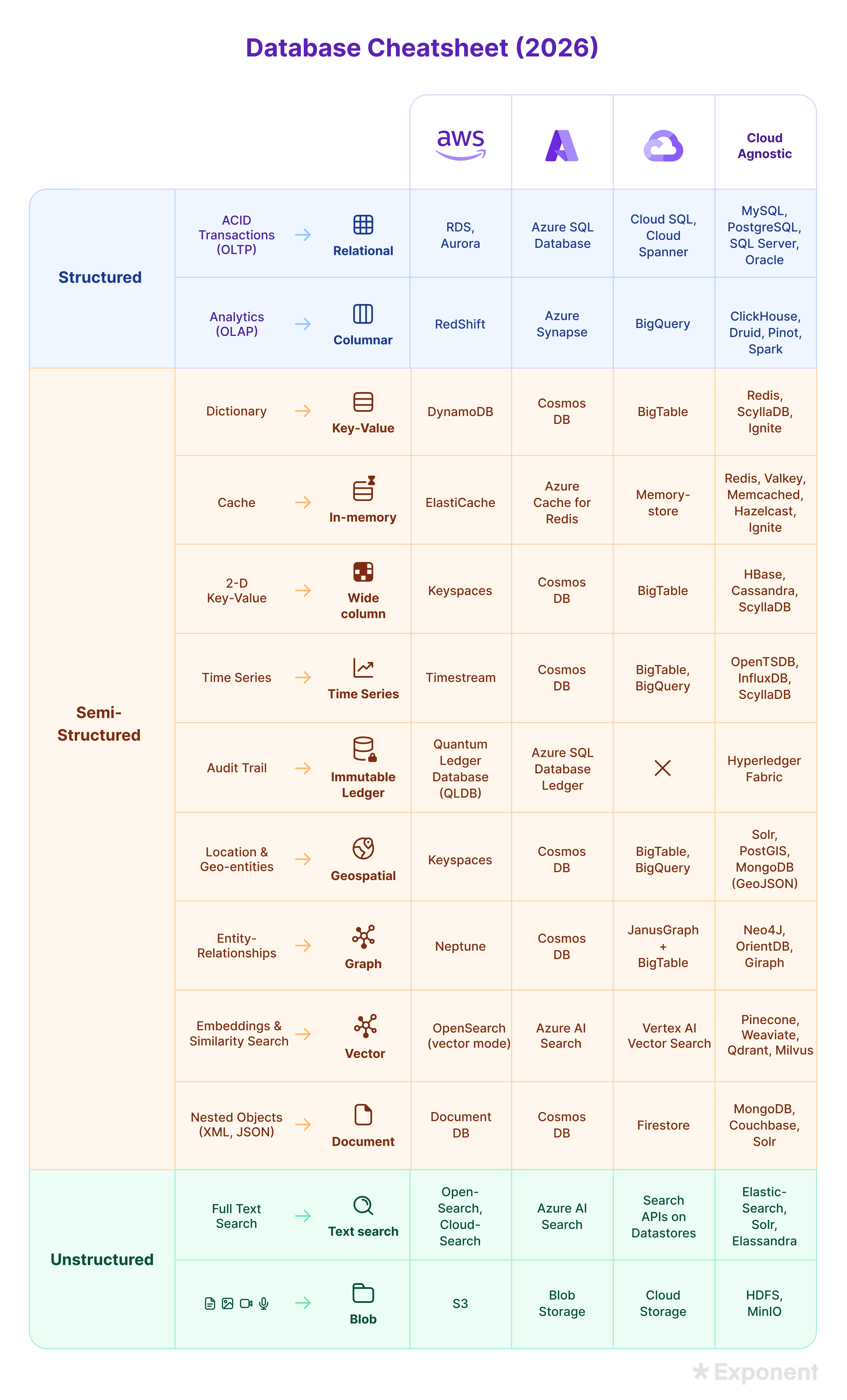
A Google EM who recently went through the loop recommended studying Google's internal database products (Bigtable, Spanner, Firestore, BigQuery) and approaching problems with their internal tech rather than defaulting to AWS or Azure. Understanding why you'd pick a specific database for a specific workload matters more than knowing Google's internal product names.
Meta's system design interview
Meta's system design round is 45 minutes for ICs and focuses on distributed systems architecture: designing products Meta actually builds, like social feeds, messaging platforms, or content delivery networks. Common prompts include "Design Instagram" or "Design a file storage system."
Meta calls the round "Pirate" internally, and some candidates now go through a "Pirate X" loop focused on API and product design. For engineering managers, the question is filtered through a domain lens: on a security-focused team, you'll design the security architecture for a system using the STRIDE framework rather than the system itself. A Meta EM we spoke with described the onsite as including a "learning systems design interview" alongside an in-depth project review, team management round, and behavioral round.
Scale is always front of mind. The interviewer expects you to proactively address how your architecture handles billions of users across Facebook, Instagram, WhatsApp, and Messenger. If you don't bring up scale yourself, your interviewer will, and reactive answers score lower than proactive ones.
Amazon's system design interview
Amazon's system design interview is unusual because behavioral questions are woven directly into the technical round. An Amazon SWE confirmed, "In the system design interview, there's also a section where the interviewer is going to ask you some behavioral questions."
Expect to design Amazon-type products (Alexa, Prime Video, a logistics system) and connect your design decisions to Amazon's Leadership Principles.
The system design screen may be entirely verbal with no whiteboard or diagram tool for GenAI roles. Practice articulating design decisions out loud without any visual aid.
Amazon often asks team-dependent interview questions. Research the products, services, and tools most related to the team you're interviewing with.
Apple's system design interview
Apple's system design interview format, duration, and domain focus vary more widely than at Google, Meta, or Amazon. The round is 45 to 60 minutes, and ICT5 candidates on some teams go through two separate system design rounds.
Questions are likely to be domain-driven and reflect the team's actual product area. Privacy, authentication, API design, and storage trade-offs come up consistently. On mobile-focused teams, Apple takes mobile system design more seriously than most companies.
Apple often asks team-dependent interview questions. Research the products, services, and tools most related to the team you're interviewing with, and be prepared to reason about on-device computation, offline behavior, and resource constraints.
Netflix's system design interview
Netflix's system design round is 60 minutes and appears once for L4 candidates, twice for L5 and above. It's an open-ended discussion with no fixed framework, and you might not draw a diagram at all: candidates in our research completed their rounds without any shared diagramming tool.
Netflix often asks team-dependent interview questions. Research the products, services, and tools most related to the team you're interviewing with.
One candidate was asked, "After you open the Netflix app and select a viewing profile, Netflix displays a collection of recommended titles organized into categories. How would you design a dynamic recommendation system?" Another candidate, interviewing for an internal tooling team, got a question about a real architectural decision the team was facing.
A Netflix SWE we spoke with said the system design round was his favorite part of the final loop because the format rewards engineers who can reason about real problems in conversation. Study the Netflix Tech Blog thoroughly; candidates who did said it was their most valuable prep resource.
Airbnb's system design interview
Airbnb's onsite loop has four technical rounds: coding, code review, system design, and architecture review (a reverse system design round where you present a past project). The code review round is rare in the industry and a strong leveling signal.
For system design, Airbnb draws from a global question bank and keeps questions intentionally vague: the candidate determines scale, device count, and data frequency. A representative example is designing an event processing system that ingests smart meter data and enriches it with an external geolocation service. An Airbnb interviewer told us:
"I really want to see how candidates think about systems and failure modes."
The architecture review asks you to present a project you've led. Some candidates bring slide decks with before-and-after diagrams; others draw on a whiteboard. The signal the interviewer looks for, in their words: "can you describe not just what you did, but why, and what decision points led you there?" At the staff level, the interviewer expects you to connect dots across teams and think beyond your immediate project.
OpenAI's system design interview
OpenAI's system design round expects you to think across the entire stack, from front-end wireframes to API design to database choices, with scalability as the central concern. Scale is the single most consistent evaluation criterion: interviewers routinely push designs to 10x, 100x, and 1000x the initial requirements to test how your architecture evolves under pressure.
OpenAI determines your level (senior or staff) only after the interview. All candidates go through the same rounds regardless of target level, and the system design rounds carry significant weight in leveling decisions.
Anthropic's system design interview
Anthropic's system design questions are framed around AI workloads, but the core problems are classic distributed systems challenges. The most commonly reported prompt involves designing a batch inference API for a GPU cluster, which tests general infrastructure patterns: queuing, batching under constraints, async-to-sync mapping, and GPU resource management.
Anthropic interviewers explicitly look for candidates who abstract the AI framing, turning "batch inference on a GPU" into "batched processing on a constrained compute resource." The bar is exceptionally high: candidates who perform well on every technical round can still get rejected, and questions lean toward novel problems where even the interviewer may not know the optimal solution.
System design interviews at Stripe and AI-first startups
Stripe and several AI-first startups run non-standard system design interview formats, from multi-part sequential builds to reverse "defend your past system" rounds.
- Stripe has moved toward a multi-part sequential format on HackerRank where each part unlocks only after the prior one passes.
- At Robinhood, candidates report being asked to design a highly distributed training system.
- At LangChain, some system design rounds are in a reverse format: "Talk about your past systems" and defend your design decisions.
- xAI technical interviews have been described as functionally equivalent to an onsite system design round.
- Sierra system design interviews ask candidates to design an agent-based system.
If you're interviewing at an AI-first company, prepare to discuss how you'd architect systems where the core compute resource is a GPU, the workload is bursty and expensive, and the output is non-deterministic.
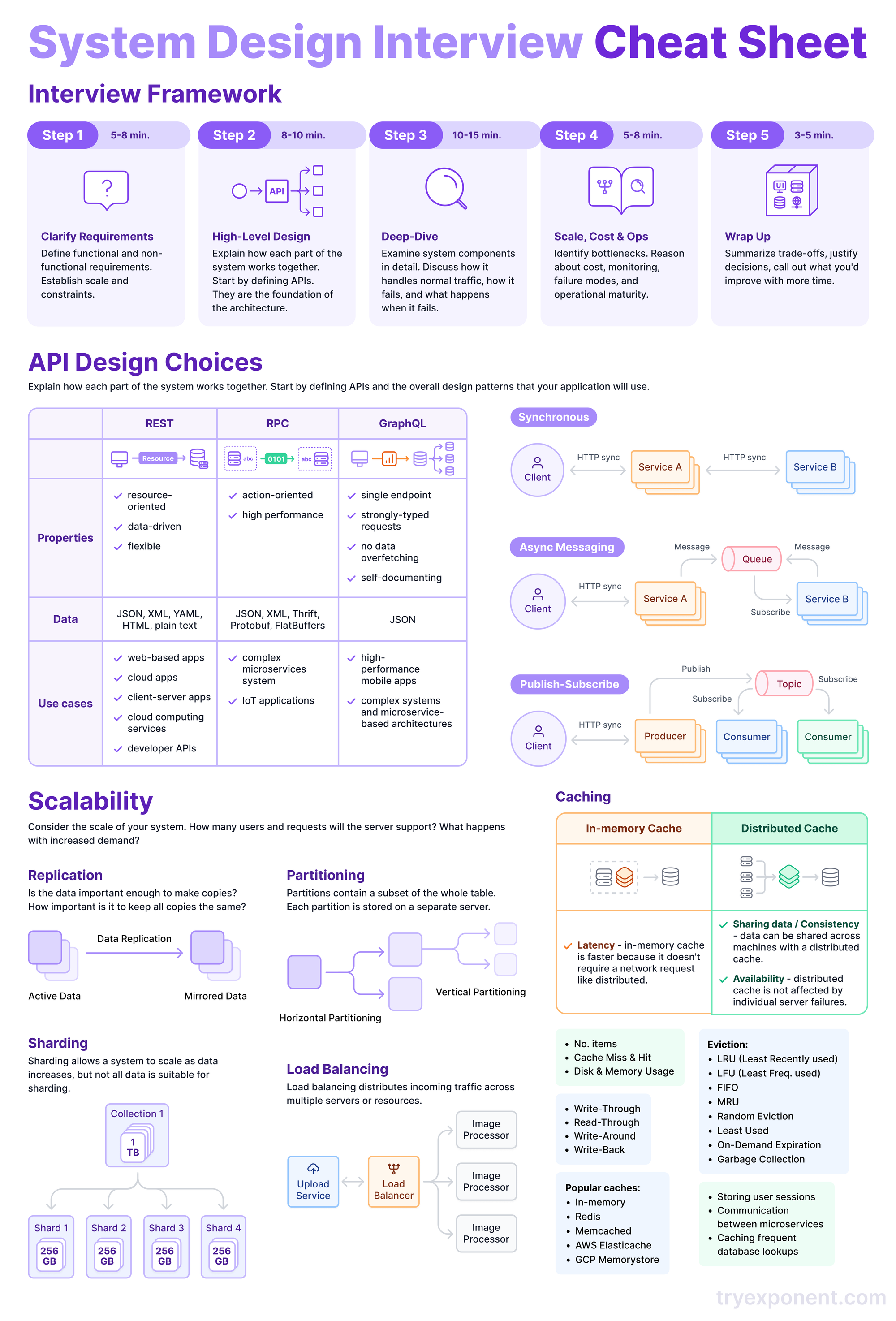
How to structure a system design interview (5-step framework)
System design interviews break into five steps: clarify requirements, sketch a high-level design, examine one or two components in detail, address scale, cost, and operations, then wrap up with trade-offs. Those steps fill the 45 to 60 minutes, and most companies follow this general shape. Netflix, Stripe, and Amazon GenAI roles are notable exceptions.
1. Clarify requirements (5 to 8 minutes)
Don't start designing before you understand the problem; ask about functional requirements first. What does the system actually need to do? If the prompt is "Design TikTok," which features matter: video upload, feed generation, search, or live streaming? The interviewer won't scope this for you, so propose a scope and get alignment.
Then ask about non-functional requirements. What matters most between availability, consistency, latency, and cost? Ask about scale (how many users, how many requests per second, how much data) and access patterns (read-heavy or write-heavy, how soon after writing is data read).
State what you're excluding, like "I'll focus on feed generation and video upload, and leave authentication and payments out of scope." This shows you can prioritize. An Airbnb interviewer described the expected approach:
"Come up with scale, functional requirements, non-functional requirements. Then establish constraints. Then jump into your main design."
The candidates he sees succeed ask good clarifying questions before drawing a single box.
2. High-level design (8 to 10 minutes)
Sketch the system's core components. Start with the API layer (what endpoints exist, what data goes in and out), then show how the major services, databases, and caches connect. Your goal is to confirm the design satisfies every functional requirement without going deep on any one component yet.
Show the data flow for each core use case. For example, if you're designing a messaging app, trace a message from the sender's client through the API, into storage, and out to the recipient. Choose your communication protocols (REST, GraphQL, gRPC, WebSockets) and data storage approach, and justify both from your requirements rather than habit.
3. Examine one or two components in detail (10 to 15 minutes)
This is the highest-signal portion of the interview, where you or the interviewer select one or two components to examine closely, going beyond performance tuning. Interviewers want to see you reason about three things at once: how the component handles normal traffic, how it fails, and what happens when it fails.
An Airbnb interviewer told us he's specifically looking for "how candidates think about systems and failure modes." At OpenAI, interviewers push designs to 10x, 100x, and 1000x the initial requirements to watch how the architecture evolves under pressure.
Consider how non-functional requirements shape your choices. If the system requires transactions, discuss ACID properties and which database supports them. If data freshness matters, discuss how to speed up ingestion and processing. If the data is large, discuss partitioning strategies and consistent hashing for load distribution. Most interviewers care more about which specific engine you'd pick, and why, for this workload than about the generic "SQL vs. NoSQL" debate.
4. Scale, cost, and operations (5 to 8 minutes)
Step back and re-examine the design for weak points. This step has expanded in 2026, and interviewers at multiple companies now evaluate cost reasoning, failure recovery, and operational maturity beyond raw scalability.
- Scale and bottlenecks: Identify the constraint, propose a mitigation, discuss the trade-off, and recommend a path forward. What breaks at 10x scale? At 100x? Where are the single points of failure? Would a CDN help latency for globally distributed users? Are there scenarios (a viral post, a flash sale, a coordinated usage spike) that would overwhelm the system?
- Cost: Reason about when to use reserved vs. spot instances, when caching saves money instead of adding complexity, and when serverless is cheaper at low scale but explodes at high scale. You don't need to quote AWS pricing; you need to treat cost as a design constraint from the start.
- Operations: Mention monitoring, alerting, and observability before the interviewer asks. Logs, metrics, traces, dashboards. How would your team know something is broken at 3 AM, and how would they debug it? Raising this type of scenario unprompted signals you've run systems in production.
5. Wrap up (3 to 5 minutes)
Summarize what you designed, which trade-offs you made, and why. Tell the interviewer what you'd improve with more time: data migration strategies, CI/CD pipeline design, more granular access controls, geographic failover. The interviewer knows you can't cover everything in 45 minutes, so showing you know what you deferred and why demonstrates critical judgment.
How to prepare for a system design interview
Two plans cover most system design interview prep: a full eight-week plan, or a compressed two-week plan if that's all the time you have. Both timelines build fundamentals first, then move to timed practice and mock interviews, with an extra week on AI/LLM infrastructure for AI-first companies.
8-week system design prep plan
An eight-week system design interview plan moves through four phases, from fundamentals to company-specific prep:
| Weeks | Focus | What to do |
|---|---|---|
| 1-2 | Fundamentals | Build a mental library of building blocks: load balancing, caching, relational and non-relational databases, message queues, CDNs, consistent hashing, replication, sharding, and the CAP theorem. Understand how they compose; don't memorize architectures for specific systems. |
| 3-5 | Timed practice | Work through 8-10 classic questions out loud in 45-minute timeboxes, using Excalidraw, Whimsical, or a physical whiteboard. Reason aloud even when practicing alone. Diagram polish doesn't matter. |
| 6-7 | Mock interviews | Run mocks with another engineer or our peer mock interview tool. Pattern recognition forms under pressure, so treat mocks as daily practice. |
| 8 | Company-specific prep | Use the company breakdowns in this guide and our company interview guides. Review weak spots and practice 1:1 system design interviews with an expert coach. |
The most common failure mode in system design interviews is memorization, so spend your time learning to compose building blocks rather than recalling reference designs. An Airbnb interviewer who received nearly 15 offers during his own job search credited daily practice: he ran an interview every day, analyzed what worked, and improved his conversion rate over weeks.
2-week system design prep plan
Compress weeks 1-2 from the eight-week system design prep plan into three days of intensive fundamentals study. Spend the remaining time on practice questions and at least two mock interviews, focused on the most commonly asked questions for your target company.
How to prepare for system design interviews with AI-first companies
Add one week to your system design prep specifically for AI/LLM infrastructure patterns. Understand how batch inference works, how GPU clusters are managed, what retrieval-augmented generation involves, and how rate limiting works for LLM APIs. You don't need to be an ML expert, but you need to understand the infrastructure patterns that support ML workloads.
How are system design interviews scored at senior vs. staff levels?
The same system design prompt is scored against a higher bar at each level: juniors are judged on basic competence, seniors on depth in their domain, and staff on cross-team influence and their ability to drive the interview.
| Level | What the interview rewards |
|---|---|
| Junior | Finding basic issues and showing competence with testing and logic. |
| Senior | Expertise in your vertical: reasoning about scalability, reliability, and maintainability, and how your design decisions affect the product's future. |
| Staff | Influence beyond your team: connecting dots across services, weighing cross-team implications, and communicating with clarity. |
In practice, staff-level candidates drive the interview. They propose scope instead of asking the interviewer to narrow it, raise non-obvious concerns (data migration paths, backward compatibility, organizational boundaries) without prompting, and pick the two most important components to examine in depth.
For example, in Airbnb's architecture review, a staff candidate is expected to articulate who the stakeholders were, why certain decisions were made, and how the project affected cross-team work. The best candidates explain the reasoning behind the reasoning.
Key concepts in system design interviews
Ten key concepts cover most system design interviews: load balancing, caching, databases, message queues, CDNs, consistent hashing, replication and sharding, the CAP theorem, API design, and monitoring. For detailed video walkthroughs, see our system design course.
- Load balancing distributes traffic across servers to prevent bottlenecks. Know the difference between Layer 4 (transport) and Layer 7 (application) balancers, and when each applies.
- Caching stores frequently accessed data in memory. Understand cache-aside, write-through, and write-behind strategies, plus cache invalidation. Know when caching helps and when it introduces dangerous staleness.
- Databases: Know when to use relational (PostgreSQL, MySQL) versus non-relational (MongoDB, Cassandra, DynamoDB, Redis). What matters in 2026 is picking the specific engine that fits the workload, and explaining why.
- Message queues enable asynchronous processing between services. Know when to use Kafka (high-throughput event streaming), SQS (simple job queues), or Pub/Sub (fan-out to multiple consumers).
- CDNs cache static content at edge locations near users, and are required for any system serving media to a global audience.
- Consistent hashing distributes data across nodes while minimizing redistribution when nodes are added or removed. Used in distributed caches and databases.
- Replication creates copies of data for durability and read scaling. Sharding partitions data across nodes for write scaling. Different problems, different solutions, often used together.
- CAP theorem: During a network partition, you choose between consistency and availability. Most production systems choose eventual consistency and design around it.
- API design: REST is the default. GraphQL gives clients flexible queries. gRPC is faster for service-to-service calls. WebSockets handle real-time bidirectional communication.
- Monitoring and observability: Logs, metrics, traces, and alerts. Mentioning this unprompted during a system design interview signals real production experience.
System design interview FAQs
How long is a system design interview?
A system design interview usually runs 45 to 60 minutes, including introductions. Netflix rounds are consistently 60 minutes, and Amazon sometimes compresses system design into a 20-minute section inside a behavioral round.
Do all companies use whiteboarding in system design interviews?
Not all companies use whiteboarding in system design interviews, and it's becoming less common. Netflix candidates often complete their round without any shared diagramming tool, Amazon GenAI roles may use a purely verbal format, and Stripe uses HackerRank for multi-part builds. Companies that do whiteboard usually use a shared tool like Excalidraw, Whimsical, or Google Drawings, so ask your recruiter which one to prepare with.
Should I prepare differently for senior vs. staff system design interviews?
Senior and staff system design interviews are scored on different bars, so yes, prepare differently. At senior level, demonstrate expertise in your domain and reason about scalability, reliability, and trade-offs. At staff level, drive the interview: propose scope, raise cross-team concerns unprompted, and show judgment about what matters most. More than one system design round is common for staff roles.
Do I need to know AI/ML for system design interviews in 2026?
You need AI/ML knowledge for a 2026 system design interview if you're interviewing at an AI-first company or a role that involves AI features. You don't need to be an ML expert, but you should understand batch inference, GPU resource management, retrieval-augmented generation, and embedding pipelines. At traditional tech companies, AI system design questions are becoming more common but aren't universal yet.
What's the best way to prepare for a system design interview?
The most effective way to prepare for a system design interview is to practice out loud with another person. Reading about system design helps but isn't enough, because the interview is a live conversation and real-time reasoning only develops through practice. Use our peer mock interview tool or practice with an expert coach.
Learn everything you need to ace your system design interviews.
Aced is the fastest-growing tech interview prep platform. Get free interview guides, insider tips, and courses.
Create your free accountRelated Blog Posts
System Design Interview: Design a Rate Limiter

The 10 Best System Design Books to Sharpen Your Skills

How to Whiteboard for System Design Interviews