Major tech companies like Shopify, Capital One, Uber, and Dropbox use take-home case studies to evaluate data analyst candidates.
If you've made it to this stage, you're close to an offer. But this round often separates good candidates from great ones.
As one data analytics hiring manager put it:
"The take-home case study is often the round that distinguishes the ultimate candidate we want to offer the position to."
This guide breaks down exactly what interviewers look for, gives you a repeatable framework for any case study, and helps you avoid the mistakes that sink otherwise strong candidates.
She led the creation of our complete data analyst interview prep course.
What is a data analyst case study interview?
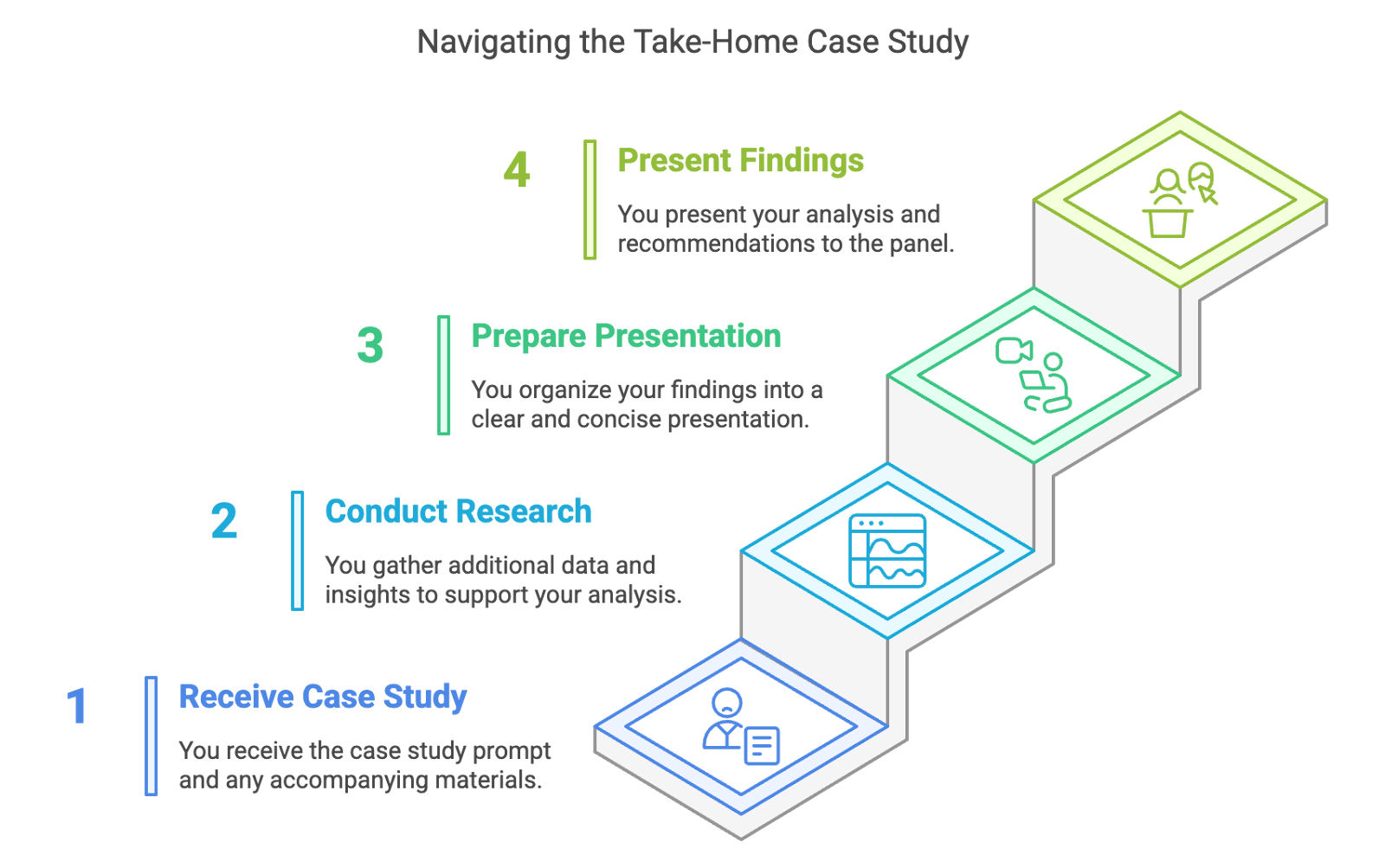
A data analyst case study interview is a take-home assignment where you're given a business problem (usually with a dataset) and asked to analyze it, draw conclusions, and present recommendations to a panel.
Unlike live technical interviews that test your ability to think on your feet, take-home case studies evaluate your ability to deliver real, insight-driven recommendations.
You're expected to analyze actual data, apply reasonable assumptions, structure a compelling narrative, and present your findings clearly and persuasively.
The typical process looks like this:
| Step | What happens |
|---|---|
| 1. Receive the prompt | You'll get a case study brief with a business problem and often a dataset |
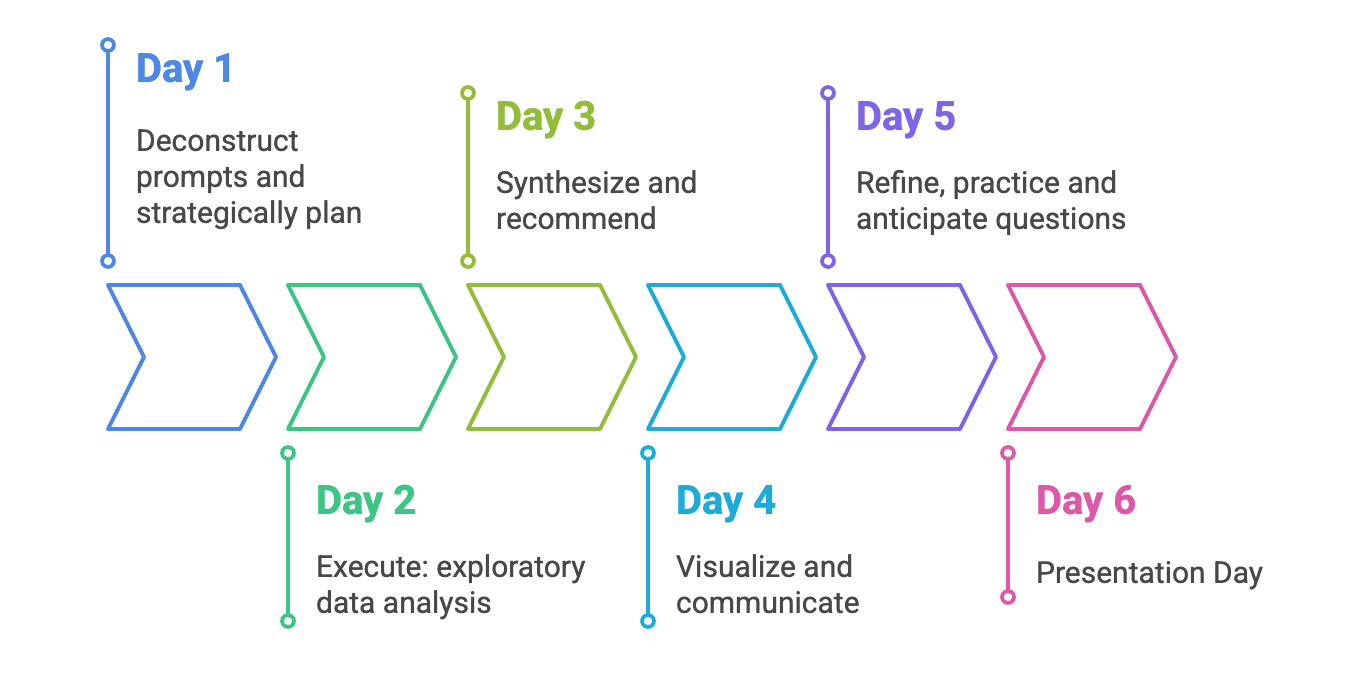
| 2. Timeline | Most companies give 4–7 days to complete the assignment |
| 3. Analysis | Use SQL, Python, Excel, or any tool you prefer to analyze the data |
| 4. Create a presentation | Prepare a deck with your findings, visuals, and recommendations |
| 5. Panel presentation | Present to a 2–4 person panel in a 45–60 minute session with Q&A |
The case study is a comprehensive evaluation of how you think, how you communicate, and how you'd operate as a teammate, all in one round.
How You're Evaluated
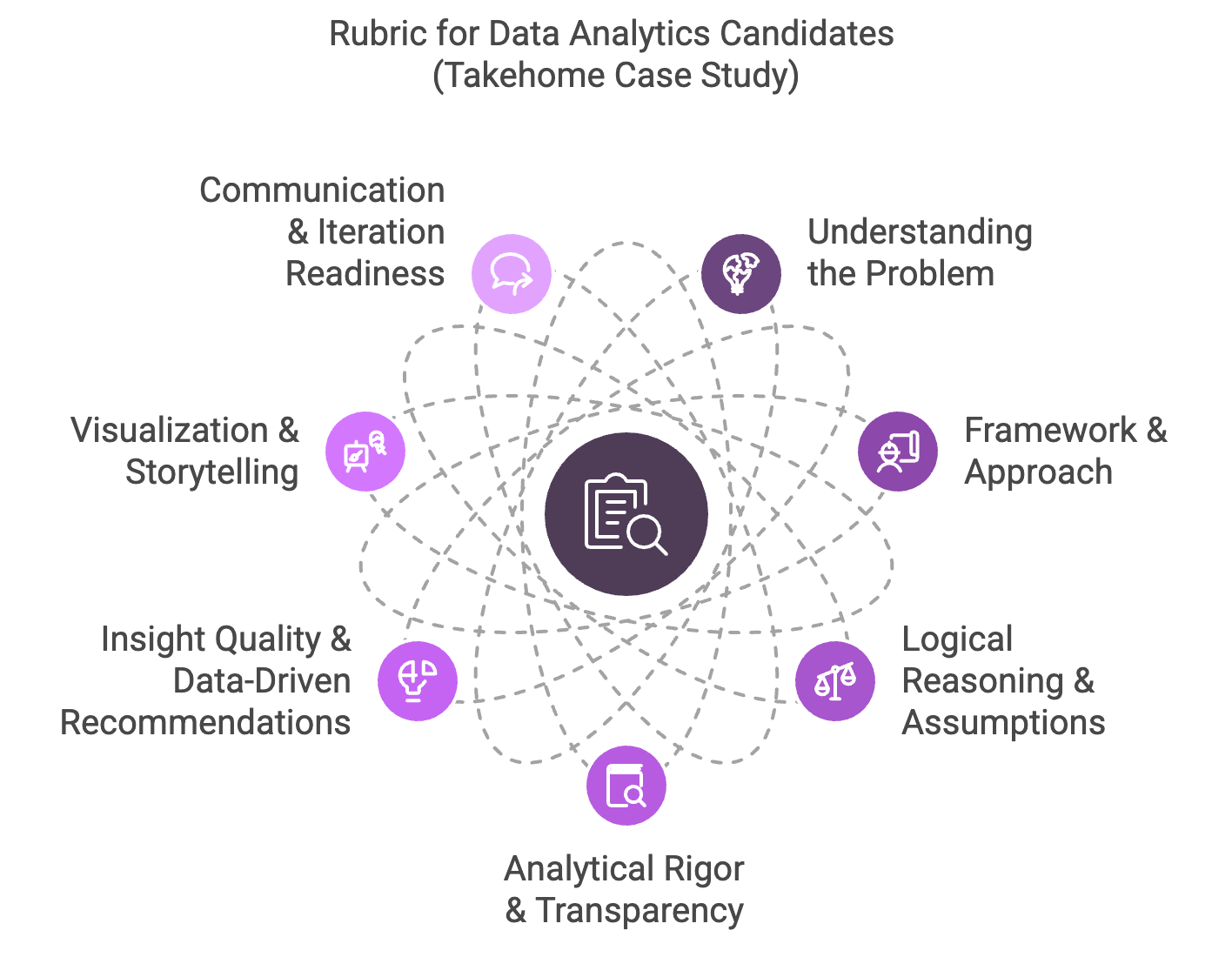
Interviewers assess data analyst candidates across seven core dimensions.
| Dimension | What they're looking for |
|---|---|
| Understanding the problem | Did you correctly interpret the prompt, define the problem, and set the right scope? |
| Framework and approach | Did you apply a clear structure to guide your thinking? |
| Logical reasoning and assumptions | Are your assumptions reasonable and clearly justified? |
| Analytical rigor and transparency | Is your analysis thorough, accurate, and well-documented? |
| Insight quality and recommendations | Are your insights derived from data and tied to business needs? |
| Visualization and storytelling | Are your visuals effective and your narrative logical? |
| Communication and iteration readiness | Does your presentation anticipate stakeholder questions? |
Strong candidates synthesize the prompt into a focused problem statement, explain their rationale, and proactively address limitations.
The best candidates connect their metrics to strategic levers and call out areas for future work before the interviewer asks.
Types of Data Analyst Case Studies
Not all case studies are structured the same way.
Understanding the type you're facing helps you calibrate your approach.

Defined vs. open-ended problems
Case studies vary in how much direction they give you:
| Type | What you're given | What's being evaluated | Example |
|---|---|---|---|
| Defined | A specific question or set of questions to answer | Execution, domain knowledge, ability to directly answer the question | "Analyze this sales data to identify the top 3 reasons for customer churn" |
| Open-ended | A vague or directional goal | Framework, thinking process, ability to gather secondary data | "How can we improve user engagement on our platform?" |
With defined problems, you're evaluated on how well you execute. With open-ended problems, you're evaluated on how well you structure ambiguity.
Both require strong analytical skills, but they test different muscles.
With dataset vs. without dataset
Most case studies include a dataset, but not all do:
| Scenario | Your focus |
|---|---|
| Dataset provided | Explore the data to define the problem, identify patterns and anomalies, and let the data guide your hypotheses |
| No dataset provided | Break down the core drivers of the problem, define what data you'd need, and use external benchmarks or logical reasoning |
When no dataset is provided, you're being tested on your ability to think through a problem conceptually.
What data would you want, what frameworks would you apply, and how would you structure your analysis if you had the right information?
Case Study Interview Framework
The key to succeeding in any case study is having a repeatable framework you can adapt to different scenarios.
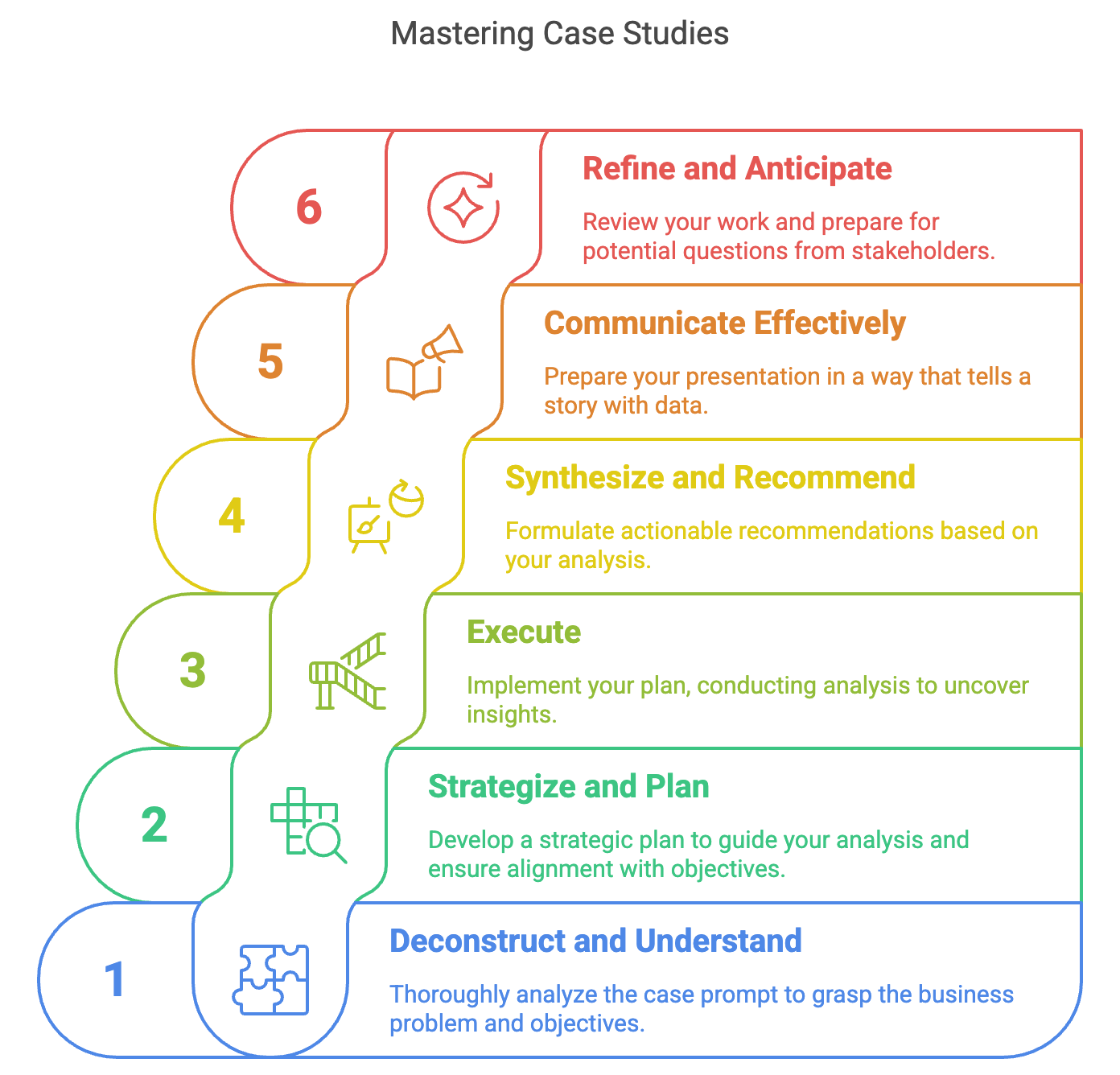
Here's the approach we recommend:
1. Deconstruct the prompt
Don't skim the prompt and assume you understand it. Take time to deeply unpack what's being asked.
Start by defining the key terms. If the prompt says "optimize sales funnel performance," what does "performance" mean? Conversion rates? Revenue per opportunity? Time to close? Explicitly defining your metrics will guide your entire analysis.
Next, clarify what success looks like. Research industry benchmarks if needed.
Knowing typical SaaS conversion rates or average sales cycles helps you contextualize your findings.
Finally, understand the business context. Is the company focused on growth, efficiency, or profitability? This priority shapes which recommendations will resonate.
If you're unfamiliar with the industry, spend time researching. Read earnings reports, look up industry standards, or talk to someone who works in the space. Interviewers expect clarity from the very first slide.
2. Plan your approach
Before writing any code or building any charts, create a structured analysis plan. This keeps you focused and ensures you don't waste time on tangents.
Your plan should address:
- What variables are critical to the analysis?
- What segments or cuts will you explore first (e.g., new vs. returning users, by region)?
- What's your working hypothesis?
- What additional data would strengthen your analysis?
A clear plan ensures discipline and efficiency. Don't make the mistake of diving straight into the data—it leads to confusion, wasted time, and weak recommendations.
3. Execute your analysis
Now put your plan into action. This is where your technical skills come into play.
If you have a dataset, perform exploratory data analysis: create visualizations, calculate relevant metrics, and look for patterns and correlations. Pay attention to data quality issues like missing values, outliers, or logical inconsistencies.
If you don't have a dataset, leverage your knowledge and resourcefulness to propose solutions based on logical reasoning and external research.
Throughout execution, document your work meticulously. Interviewers may ask to see your working files, and having clean documentation shows professionalism and attention to detail.
4. Synthesize and recommend
Analysis alone isn't enough—you need to translate your findings into actionable recommendations.
Your recommendations should be:
- Specific: Not "improve marketing" but "increase investment in affiliate partnerships in Q3"
- Data-backed: Tied directly to insights from your analysis
- Relevant: Aligned with the business goal stated in the prompt
One powerful approach is to develop a scoring framework that weighs multiple factors. For example, if you're evaluating marketing channels, you might weight conversion rate, revenue per deal, and time to conversion based on the company's priorities.
This kind of structured synthesis shows interviewers that you can integrate multiple data points into a coherent recommendation—not just report numbers.
5. Communicate effectively
Your presentation is where you demonstrate executive presence. You're telling a story that leads to action.
Structure your presentation to make it easy for a non-technical audience to follow:
- Executive summary: The problem, your approach, key findings, and top recommendations—all on one slide
- Problem definition: Your interpretation of the prompt and key assumptions
- Methodology: How you approached the analysis (keep it brief)
- Key findings: The 3–5 most important insights, with clear visuals
- Recommendations: Actionable next steps tied to your findings
- Operational plan (optional): How recommendations could be implemented
- Next steps (optional): Further analysis you'd do with more time or data
- Appendix: Supporting charts and data for follow-up questions
Remember: stakeholders care about the "so what" and the "what next," not the technical details of your code. Focus on business implications.
6. Refine and anticipate questions
Before you present, stress-test your work.
Review your analysis for weaknesses in logic, calculations, or assumptions. Practice your delivery out loud—this helps you identify unclear explanations. Most importantly, anticipate what the panel will ask.
Prepare for questions about:
- Your methodology: Why did you choose this approach?
- Your assumptions: What did you assume, and how would different assumptions change your conclusions?
- Your findings: What data supports this? Are there limitations?
- Your recommendations: Are they practical? How would you measure success?
- Alternative perspectives: What other interpretations did you consider?
Strong candidates don't just answer questions—they've already addressed the most likely concerns in their appendix.
Example Take-Home Case Study
To make this concrete, here's an example of a real case study prompt similar to what you might receive from a major tech company:
Prompt: Assist ABC Inc., a cloud solutions provider, to optimize the performance of their sales funnel and focus on the right leads.
You're provided with a dataset containing quarterly data on marketing channels, customer types, countries, leads, opportunities, closed deals, revenue, and average days to conversion.
At first glance, this seems straightforward. But applying our framework reveals the complexity.
Deconstructing the prompt: What does "performance" mean—conversion rate, revenue, speed? What makes a lead "right"—high conversion, high revenue, low acquisition cost? What's ABC Inc.'s priority—growth or profitability?
Planning your approach: You'd want to analyze performance by marketing channel, segment leads by profitability, identify funnel bottlenecks, and examine trends over time.
Executing the analysis: You might find that affiliate partnerships have the highest conversion rate but generate lower revenue per deal. How do you reconcile that?
Synthesizing: You could develop a weighted scoring model that balances conversion efficiency against revenue potential, adjustable based on business priorities.
Presentation Structure
Your presentation structure can make or break your case study.
Here's a proven format:
| Section | Purpose | Slides |
|---|---|---|
| Executive summary | Give the panel the full picture upfront | 1 |
| Problem definition and assumptions | Show you understood the prompt and scoped it correctly | 1 |
| Methodology | Briefly explain your approach | 1 |
| Key findings | Present your most important insights with visuals | 3–5 |
| Recommendations | Actionable next steps tied to findings | 1–2 |
| Operational plan | How to implement (optional but impressive) | 1 |
| Next steps | Further analysis with more time/data | 1 |
| Appendix | Supporting details for Q&A | As needed |
Keep slides clean and legible. Aim for 2–3 sentences per paragraph max.
If text gets lengthy, break it across multiple slides. Use the company's visual identity if possible.
Common mistakes to avoid
Based on feedback from interviewers at top tech companies, here are the mistakes that sink otherwise strong candidates:
- Burying your assumptions. Don't leave assumptions until the end or only mention them when questioned. State them upfront. It sets context and shows structured thinking. Candidates who bury assumptions appear unstructured or like they're guessing.
- Not showing your work. Document your calculations and data manipulation steps meticulously. Interviewers may review your working files. Having clean, transparent documentation demonstrates professionalism.
- Jumping to solutions. Don't dive into analysis before fully understanding the problem. Candidates who skip the deconstruction step often solve the wrong problem or miss key nuances.
- Being defensive when challenged. Interviewers will push back on your conclusions—that's the point. Don't dig in defensively. Acknowledge the feedback, explain your reasoning, and show willingness to refine your approach.
Ignoring the business context. Technical analysis means nothing if it's not tied to business impact. Always connect your findings to what the company actually cares about.
Q&A and Pushback
The Q&A portion is where interviewers separate good candidates from great ones. Your goal isn't to have all the answers—it's to demonstrate how you think under pressure.
When you anticipated the question, say something like:
"That's a great point—and something I considered during my analysis. I included a breakdown in the appendix that addresses this."
When you didn't anticipate it, respond gracefully:
"That's a really insightful observation. I hadn't considered that angle in depth. Based on that, I'd want to look into [specific data] and potentially refine my recommendation to account for [their point]."
This approach shows intellectual curiosity, adaptability, and collaboration.
The strongest candidates don't get defensive; they treat pushback as an opportunity to demonstrate their thinking.
How to Prepare
The take-home case study is often the final hurdle between you and an offer.
With the right framework and preparation, you can walk into your presentation with confidence.
To recap:
- Deconstruct the prompt thoroughly before touching the data
- Plan your analysis with clear hypotheses and structure
- Execute with rigor and documentation
- Synthesize findings into actionable recommendations
- Communicate with executive presence
- Refine and anticipate tough questions
For more hands-on practice, explore our data analytics take-home case study course, which includes real prompts, datasets, and expert walkthroughs.
You can also sharpen your analytical problem-solving skills with our case walkthrough lessons.
Your Aced membership awaits.
Aced is the fastest-growing tech interview prep platform. Get free interview guides, insider tips, and courses.
Create your free accountRelated Courses

Data Analyst Interview Prep Course
Behavioral Questions for Data Analysts
Related Blog Posts
35+ Data Analyst Interview Questions & Answers (2026 Guide)

What is a Data Analyst? Role and Career Insights